

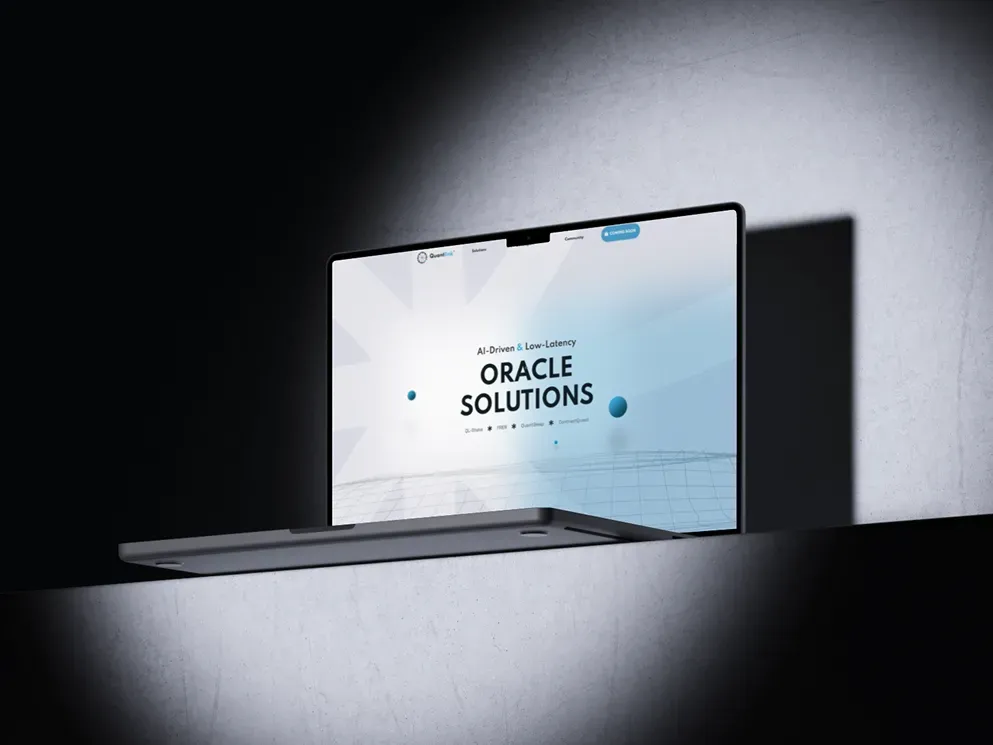
Web development agency: the short answer
A web development agency builds the engineering behind your website: front-end, back-end, integrations and ongoing maintenance. A web design agency decides how the site looks; web development services decide whether it works, loads fast and scales. Professional custom builds in the Netherlands typically run €3,000 to €15,000.
That distinction sounds academic right up to the moment it costs you money. The failed website projects we inherit almost never failed on taste. They failed on engineering: a site that loads slowly, a form that submits into nowhere, a CMS nobody dares touch, or a codebase the previous supplier still holds the keys to. This guide covers what a web development agency actually does, how it differs from a design agency and a freelancer, which stack fits your situation, and the part almost nobody writes about honestly: how to verify quality when you cannot read a line of code.
5.0 ★
on Google (30 reviews)
Herengracht
our office in central Amsterdam
€15,000
indicative market range for custom builds
4 disciplines
development, SEO, branding and automation
What does a web development agency actually do?
A web development agency turns a design and a business goal into working software that runs in a browser. The work splits into four layers, and a serious agency can account for all four.
HTML, CSS and JavaScript that turn a design into a working interface. This layer decides whether your site is usable on a phone on a train in under a second, or after five.
Server, database, CMS and the logic around them. Orders, enquiries, user roles, payments. If the front-end is the shop window, this is the warehouse and the till.
The connections to your CRM, accounting, inventory, calendar or payment provider. This is where most projects overrun, and where most quotes are quietly optimistic.
Deployment, monitoring, security updates, backups and documentation. A website is not a product that is finished; it is a system that runs.
Two more things belong on that list. They look technical but they are commercial: building the site to be found, and building it to be measured. Findability starts in the code with semantic markup, clean HTML, fast loading and correct structured data. Measurement starts with deciding which action matters on every page. Anyone who touches either of those after launch has already lost ground.
Web development agency vs web design agency vs freelancer
The difference is the question each one answers. A web design agency answers “how should this brand feel?”. A web development agency answers “how does this system work?”. A freelance developer answers both, alone.
| Web design agency | Web development agency | Freelance developer | |
|---|---|---|---|
| Core question | How does it look and feel? | How does it work and scale? | Both, within one calendar |
| Strong at | Brand, UX, visual direction | Architecture, integrations, performance | Speed, short lines, price |
| Weak at | Complex integrations, scale | Brand feel, when design is absent | Continuity during illness or exit |
| Typical project | Restyle, campaign site | Platform, webshop, custom build with integrations | Smaller sites, iteration, fixes |
| Indicative price | €2,500 – €10,000 | €5,000 – €40,000+ | €50 – €95 per hour |
| Biggest risk | Beautiful but slow | Technically sound but brandless | A bus factor of one |
In practice, plenty of agencies claim all three roles. That is not necessarily false — Viralistic does design and development in-house too — but it is testable. Ask who writes the code, how many people can maintain it, and whether design and development sit in the same team or route through a subcontractor. The answer tells you more than any portfolio will.
If you want the design side or the custom-build buying guide instead, we have written both: see website design in Amsterdam for the design discipline and custom website development for the full buyer’s guide.
When a freelancer is the better call
Hire a freelance developer when the scope is clear and bounded, you can direct the project yourself, and a few weeks of standstill would not hurt. For a marketing site with four templates and one form, a good freelancer is usually faster and cheaper than an agency.
Hire an agency once several systems have to talk to each other, several disciplines are involved, or the site carries revenue directly. Not because an agency writes better code, but because continuity becomes a feature. You are not paying the difference for cleverness; you are paying it so someone else is available when the first person is not.
What people mean by “web development agency amsterdam”
Search queries such as “web development agency amsterdam” almost always signal a buyer who wants two things at once: senior engineering and a team in the same timezone they can actually sit down with. Amsterdam is a dense market of scale-ups, hospitality, finance and creative studios, and proximity still matters when a build involves your internal systems and your own staff.
Location earns its keep in exactly three places: workshops at the start, testing with your real team, and the awkward conversations mid-project that go far better in person. It earns nothing at all in code quality. Judge a local agency by the same objective checks you would apply to one on the other side of the world, then treat the office address as a tiebreaker rather than a qualification.
The stack question: WordPress, headless or custom?
There is no best stack, only one that fits how often you change things, who maintains them and how heavily you lean on organic search. All three of these are the right answer somewhere.
Runs a large share of the web and excels when non-technical people publish daily. Rich plugin ecosystem, developers everywhere. The cost: plugin stacks turn slow and fragile when nobody maintains them.
Content decoupled from presentation and served over an API. Ideal when the same content feeds a site, an app and a screen. The cost: more moving parts and a steeper start for editors.
A hand-built front-end on a modern toolchain, often statically generated. Maximum control over speed and markup. The cost: you need a partner who can genuinely maintain it.
For our own projects we usually choose Astro, and this blog runs on it. So this is our own production environment rather than a tip we picked up somewhere: no JavaScript reaches the browser unless we ask for it, content collections validate every article’s frontmatter against a schema, and a malformed post fails the build instead of shipping a broken page. The payload stays small and Core Web Vitals land well without heroics.
Being honest about the trade-off matters more than defending the choice. Astro is a poor fit for a shop with thousands of products changing daily, and WordPress is an excellent fit for an editorial team of five publishing every morning. When an agency gives the same technical answer regardless of your question, it is selling its own convenience rather than your outcome. Work through the trade-offs in headless CMS explained before you commit to anything.
The question that settles the stack debate
Do not ask “which system is best?”. Ask “who changes this in two years, and how often?”. If your own team edits content weekly, a mature CMS wins. If little changes but every millisecond and every search position counts, static-first wins. That single question prevents most expensive mistakes.
Integrations and APIs: where projects really stall
Integrations are the biggest source of delay and overruns in web development, and the part quotes specify least. Building a form takes hours. Getting that same form reliably into a CRM, with duplicates caught, failures logged and GDPR-compliant retention, takes days.
So interrogate every integration on four points before you sign:
- Is there a documented API? If not, it becomes scraping or manual work, and it breaks with every update on the other side.
- Who owns the accounts and API keys? You, ideally, from day one.
- What happens when the integration fails? A good build logs the error, retries and alerts a human. A bad one loses the lead in silence.
- What does maintenance cost when the third party changes its API? That belongs in the contract, not in a surprise invoice.
This is precisely where web development meets automation. A site that drops leads into your CRM, prepares quotes and triggers follow-up pays for itself faster than one that is merely attractive. If your requirement runs past a website into a portal, a dashboard or an internal tool, you are really in the territory covered in software development in the Netherlands.
What do web development services cost?
Web development services in the Netherlands run from roughly €250 for an off-the-shelf theme to €40,000 and beyond for a platform with integrations. The spread is enormous because the word website covers everything from a business card to business-critical software. The ranges below are indicative and drawn from publicly advertised Dutch rates, not from a quote of ours.
| Project type | Indicative market range | What you generally get |
|---|---|---|
| Theme or template site | €250 – €2,500 | Existing theme, limited customisation, your own content. Live quickly, little distinctiveness. |
| Professional custom build | €3,000 – €15,000 | Bespoke design, bespoke templates, SEO foundation, one or two integrations. |
| Webshop or platform | €15,000 – €40,000+ | Product structure, payments, stock, multiple integrations, a real testing phase. |
| Ongoing maintenance | €75 – €250 per month | Hosting, updates, backups, monitoring and small changes. |
For calibration: Dutch providers such as wjwebdesign advertise sites from €249 and Yourhosting from €450, while agencies like Stuurlui place a website build between €3,000 and €15,000 and Websteen cites an overall range of €750 to €40,000 and up. Both extremes are honest. They simply describe different products.
What actually drives the price
Not the page count, despite what most people assume. Five things do: the number of unique templates, the number of external integrations, whether content has to be migrated, whether the site is multilingual, and how strict the requirements are around speed and accessibility. Twenty pages on four templates costs less than eight pages on eight templates.
The full cost breakdown with worked examples lives in how much does a website cost.
Curious what your project realistically costs?
Book a free orientation call. In one online conversation we will tell you honestly what your project needs, roughly what it costs, and whether we are the right team for it.
How to judge a developer when you cannot read code
You do not need to read code to verify quality. You only need to know where to look. Nearly every guide online says “review the portfolio and read the reviews” — but a portfolio shows taste, not craftsmanship, and reviews measure the working relationship, not the codebase. These checks are objective, and you can run them yourself on any site an agency puts in its portfolio.
Run three portfolio sites through Google PageSpeed Insights. Read the field data, not just the lab score. An agency that sells speed and scores amber on its own work is selling a story.
Tab through a form. Can you see where the focus sits? Does the menu work? Accessibility carries legal weight in the EU and is a reliable proxy for general care.
Right-click, view source. Do you see real headings and text, or an empty shell that loads everything through script? The latter leaves you dependent on how well crawlers render your pages.
The answer should be you, on your own account, from day one. Any other answer means switching supplier later becomes a negotiation instead of a handover.
Where it runs, how to deploy, where the keys live, how to restore a backup. If that document does not exist for current clients, it will not exist for you either.
Everyone has one. A senior team explains what happened and what changed structurally. Anyone claiming a spotless record has either built too little or learned too little.
The seventh check matters most and costs nothing: ask them to explain a technical decision in plain language. Someone who genuinely understands a trade-off can explain it to a non-technical director, downside included. Jargon with no downsides attached is a sales pitch.
For the metrics behind speed and stability, see Core Web Vitals explained.
How Viralistic approaches web development
We are a small, senior team on the Herengracht in Amsterdam, bringing development, SEO, branding and AI automation under one strategic direction. No management layers, no resold hours. You talk to the people who build it.
Combining those disciplines is an engineering decision rather than a marketing line. A site that is fast but invisible is an expensive brochure. A site that is visible but does not convert is traffic without revenue. So we build findability into the code itself, with clean semantic markup that both Google and AI assistants can parse, and we connect the site to the systems that carry the work afterwards. Our SEO work runs on the same principle: senior specialists with a strategic view, amplified by automation, so quality goes up while cost comes down.
SilverDrive, a chauffeur service operating in Amsterdam and across Europe, is the clearest example. Joshua Faerber of SilverDrive puts it this way, in translation: “Viralistic guided SilverDrive into an internationally focused company running entirely on organic findability. The website and all the systems save us an enormous amount of time.” We built on that same foundation for brands including Quantlink, Partible, Julia Clinics and Wolf Pack Group.
When we say no
If a custom build does not suit your situation, we say so in the first conversation. If you need a simple site and little changes, a solid theme or a good freelancer serves you better than we would. An honest no costs less than the wrong project.
Frequently asked questions
What are web development services?
Web development services cover building and maintaining websites and web applications: front-end development, back-end development, CMS setup, integrations with other systems, hosting, security and performance work. Agencies usually bundle them with design, SEO and ongoing maintenance so one team stays accountable for the whole system rather than a single layer of it.
How much does a website development service cost?
In the Netherlands, expect roughly €250 to €2,500 for a theme-based site, €3,000 to €15,000 for a professional custom build, and €15,000 to €40,000 or more for a webshop or platform with integrations. Price follows the number of templates, integrations and languages far more than the number of pages.
What is the difference between a web design agency and a web development agency?
A web design agency shapes how a site looks and feels: layout, colour, typography and user flows. A web development agency builds the engineering underneath: code, database, integrations, speed and security. Design determines the impression; development determines whether the site works, stays fast and keeps running.
How do you find a good web development company?
Test rather than browse. Run their portfolio sites through PageSpeed Insights, tab through them with a keyboard, view the page source, and ask who will own the repository and the handover documentation. Then ask them to explain one technical decision, downsides included. Portfolios show taste; these checks show craftsmanship.
What are the big 3 of web development?
HTML, CSS and JavaScript. HTML provides structure and meaning, CSS handles presentation and layout, and JavaScript adds behaviour and interactivity. Every framework, CMS and site builder ultimately produces those three. That is why an agency’s raw HTML output tells you a great deal about the quality underneath.
Will web development be replaced by AI?
No, though the work is shifting. AI tools now generate boilerplate, scaffold components and speed up routine tasks considerably. What they do not do reliably is architecture, integration with your specific systems, accessibility, security and long-term maintenance decisions. AI has become an excellent starting point and a poor finishing point for business-critical builds.
Is web development still worth it in 2026?
Yes. Every business needs a presence it controls, and the parts AI cannot automate are exactly the parts that carry commercial risk: system integration, performance, accessibility and maintainability. What has changed is the premium on judgement over typing speed, both for developers and for the agencies hiring them.
What is the 3 second rule in web design?
The three-second rule holds that a site must load and communicate its value within about three seconds or visitors leave. Treat it as a useful heuristic rather than a hard threshold. In practice it measures two separate things: technical loading speed, tracked by Core Web Vitals, and message clarity above the fold.
Conclusion
Choose a web development agency on verifiable craftsmanship rather than the prettiest portfolio: measurable speed, integrations that actually work, a stack matched to how often you change things, and a handover that leaves the keys in your hands. Design determines how your site looks; development determines whether it does its job. Professional web development services in the Netherlands realistically cost €3,000 to €15,000, and the checks above tell you within half an hour whether a team is worth it.
Looking for a web development agency in Amsterdam?
We build fast, findable sites wired into the systems behind them. Book a free orientation call and find out in one conversation what your project actually needs.
