
Most companies that ask for a new logo actually need the system around it. When the website, the sales deck and the LinkedIn page each look slightly different, the brand feels smaller than the business behind it, and every new piece of content becomes a fresh debate about colours and fonts.
Brand identity design solves that by turning a set of loose choices into one system, built on strategy rather than taste. This guide covers what a brand identity package should include, what makes the design hold up in daily use, how the process works, what it costs, how to brief a designer and which files and rights you should hold when the project ends. Prices come from Clutch’s verified client reviews and Upwork’s own rate data, the legal side from the US Copyright Office. The practice comes from our own work: at Viralistic every branding project starts with strategy, and the brand guide we made for Vianen KVS followed exactly that order.
What is brand identity design?
Brand identity design is the work of translating who a brand is into a recognisable visual system. It covers the logo, colour palette, typography, imagery, graphic elements and the guidelines that tell everyone how to use them. Corporate identity design is a closely related term, used mostly for the identity of a company as a whole.
The visual system sits inside something larger. Your brand identity also includes your positioning, your story and your tone of voice. Design is the visible layer of that identity. A designer who starts drawing before the positioning is clear will produce something that looks finished but says very little.
| Term | What it is | Example |
|---|---|---|
| Logo | The mark or name as an image | Wordmark, symbol, monogram |
| Visual identity | The system around the logo | Colours, type, imagery, templates |
| Brand identity | Who the brand is, in words and visuals | Positioning, story, voice, visual identity |
| Branding | The ongoing work of building and protecting that identity | Strategy, design, roll-out, governance |
What does a brand identity package include?
A professional brand identity package has a stable core and a set of applications. The core rarely changes. The applications grow with the business.
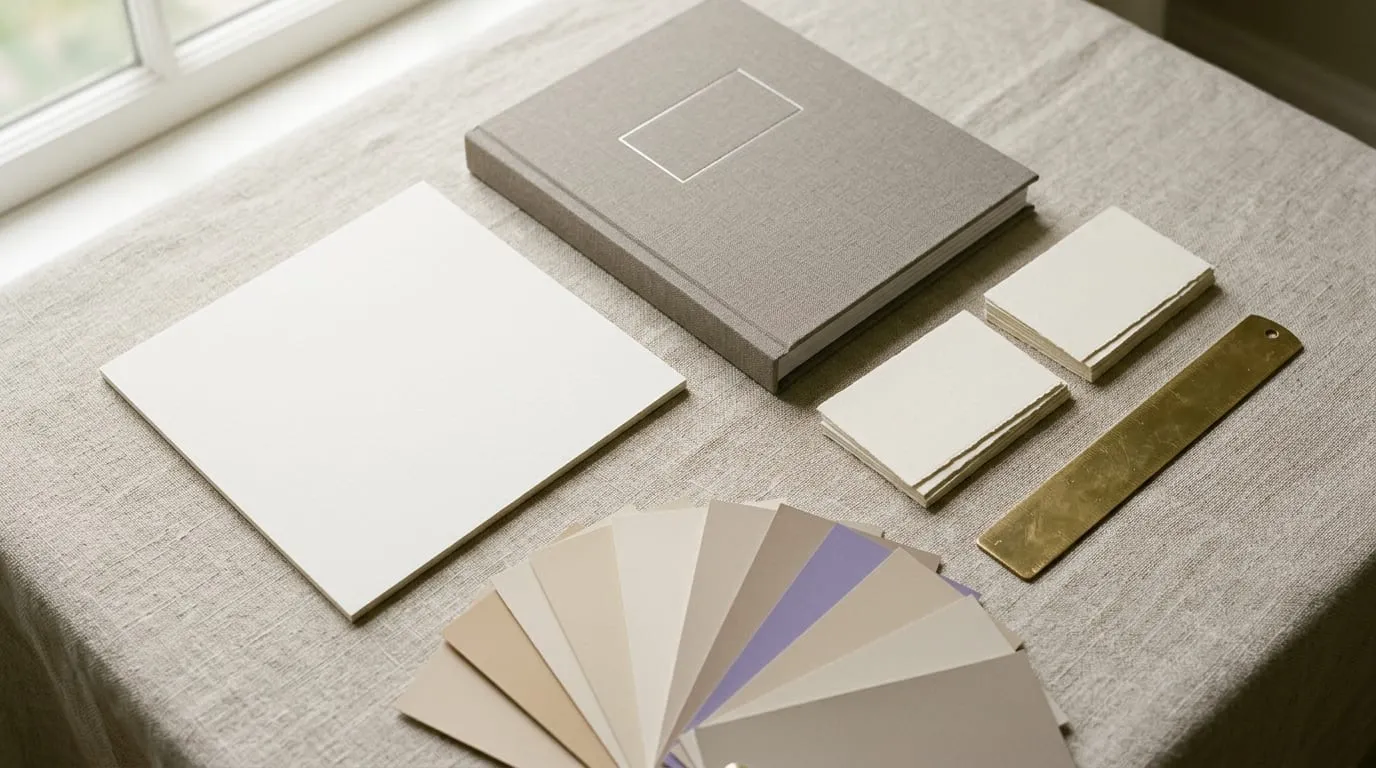
The core starts with a logo system: a primary logo, a compact version, a standalone symbol, a favicon and versions for light and dark backgrounds and in a single colour. Next to it sit a colour palette with primary and secondary colours, specified in HEX and RGB for screens and CMYK and Pantone for print, and typography for headlines and body text, with rules for size, weight and spacing. An imagery style describes photography, illustration and icons, including what to avoid, while graphic elements and a layout grid hold everything together. The brand guidelines, sometimes called a brand style guide or brand book, document every rule with correct and incorrect examples.
Applications depend on what you sell and where you sell it: business cards, email signatures, presentation and proposal templates, social media templates, signage, uniforms, packaging and, almost always, the website. Agree upfront whether each application is a mock-up or a finished, editable file your team can use.
Two things often sit outside a standard package. The first is verbal identity: your messaging, naming and tone of voice. Many agencies offer it as a separate project, and it belongs before the visual work, not after it. The second is photography. Describing an imagery style is not the same as having your own images. If you want consistent shots of your product, team and workspace, plan a dedicated photography project.
What makes a good brand identity design?
A good brand identity design is recognisable, distinctive and usable at every size. Beautiful is not enough: the system has to work as a favicon in a browser tab and on a building, on screen and on paper, and in the hands of a colleague who will never read the guidelines cover to cover.
Run a design past these tests before you sign it off:
- People recognise the brand by colour, shape and type before they read the name.
- Placed next to three competitors, it resembles none of them.
- The logo works as a favicon, on a business card and on a sign at the entrance, and has a one-colour version for engraving, embroidery and stamps.
- Every colour is specified for screen and for print, so your blue does not turn dull at the printer.
- Text in your brand colours stays legible for everyone, including on a phone in direct sunlight.
- The system can absorb a new service, a sub-brand or a campaign without starting over.
Most brand identity guides skip the legibility test, and that is exactly where it breaks in practice. According to the W3C explanation of WCAG success criterion 1.4.3, normal text needs a contrast ratio of at least 4.5:1 against its background and large text 3:1. Text that is part of a logo is exempt. Your logo may sit in pale grey on white, but your buttons, headings and body copy in that same shade may not. Ask your designer to state, for each colour, which text and which backgrounds it is approved for.
How does the design process work?
Almost every serious designer follows the same order: understand, design, document. The real difference between providers is how much time goes into the first stage.
- Discovery and briefing. You explain who you are, what you sell, to whom, and why you need a new identity now.
- Strategy and research. The designer studies your market, competitors and audience, and defines what the brand must communicate. Every later decision rests on this stage.
- Concept. One or more creative directions, ideally shown in real applications such as a homepage or a proposal.
- Feedback and refinement. A fixed number of revision rounds, agreed in advance.
- System build. The chosen direction becomes a complete system: logo variants, colours, type, imagery, templates.
- Delivery and roll-out. Guidelines, final files and the translation into your most important channels.
Fast branding services, such as fixed packages or design contests that deliver in days, mostly compress or skip stage 2. That can be fine for a side project. It is a risk for a company whose brand has to carry a premium price. At Viralistic, branding always starts with strategy: who you are, who you are for, what you must communicate at first contact and how the brand should feel to someone who has never heard your name. Read more about our branding approach.
How much does brand identity design cost?
Brand identity design costs anywhere from a few hundred dollars for a template-based package to tens of thousands for an agency project with strategy. Two public data sources make the range concrete.
| Source | What it measures | Figure |
|---|---|---|
| Clutch Branding Pricing Guide 2026 | Branding projects reviewed on Clutch | Most cost $10,000 to $49,999 |
| Clutch Branding Pricing Guide 2026 | Average agency hourly rate, United States | $100 to $149 |
| Clutch Branding Pricing Guide 2026 | Average agency hourly rate, United Kingdom | $50 to $99 |
| Upwork | Graphic designers on Upwork | $15 to $150 an hour, median range $15 to $35 |
Clutch also reports an average project cost of $71,651.70 and a typical timeline of eight months, based on verified client reviews. A handful of large projects can pull an average up, so the $10,000 to $49,999 band is the more useful reference for a single company identity. On the freelance side, Upwork’s hiring guide puts the average graphic designer on the platform at around $25 an hour.
Put the hourly rates side by side and you see how far apart agencies and freelancers sit.
- Low end of range
- High end of range
| Low end of range | High end of range | |
|---|---|---|
| Agency, US (Clutch) | $ 100 | $ 149 |
| Agency, UK (Clutch) | $ 50 | $ 99 |
| Upwork median | $ 15 | $ 35 |
Sources: Clutch Branding Pricing Guide (April 2026); Upwork graphic designer rates (2026)
What drives the price?
The strategy upfront moves the price most. Positioning, audience research and messaging take time, and they decide whether the design means anything. After that, every extra application, from a proposal template to packaging, adds hours. So do concepts and revision rounds: three directions with unlimited feedback cost more than one well-argued direction with two rounds. A one-page colour and font sheet is a very different job from a full brand book with imagery, grid and channel examples, and an identity that must work in a website, a product interface or motion needs more design work.
Paid fonts, stock imagery and a full transfer of copyright or source files are often priced separately. And an agency with strategists, designers and project management charges more than a solo designer, because it carries that experience and overhead.
Printing costs are usually separate. Viralistic does not publish a fixed price for branding, because the scope differs too much from brand to brand. It starts with a conversation about your goals, where we decide together what is needed.
Freelance designer or branding agency?
A freelance brand identity designer is usually cheaper and easier to reach. A branding agency more often brings strategy and capacity. The right choice depends on what you need besides the design itself.
| Freelance designer | Branding agency | |
|---|---|---|
| Price | Lower rate, little overhead | Higher, includes project management |
| Strategy | Varies widely by person | Usually part of the process |
| Capacity | One person, exposed to illness or peaks | A team, more continuity |
| Roll-out | Often strong in logo and print | More often web, campaigns and content too |
| Contact | Direct with the maker | Sometimes through an account manager |
There is a third model: one strategic lead who directs brand, website and growth together. It prevents the familiar problem where the designer, the web developer and the marketer each build their own version of your brand. If you are planning a new site as well, read what goes into building a website and how we approach webdesign.
How to brief a designer or agency
A clear brief saves revision rounds, and revision rounds cost money. The briefing you can download with this article follows these points:
- Who you are, in one sentence an outsider would understand.
- Who you serve, and who you deliberately do not.
- Why now. A launch, growth, a merger, a new market or a brand that no longer fits.
- Competitors and how you want to differ from them.
- What must stay. A name, colour or element customers already recognise.
- Where the identity must work. Website, proposals, social media, signage, packaging, print.
- Who decides and how many feedback rounds you expect.
- Budget and deadline, as honestly as you can.
- What you want to receive: which files, templates and rights.
- References of brands you admire, and why.
If you cannot yet say clearly who your brand is for and what it should say, start one step earlier with your digital strategy. A designer can give your positioning a form. A designer cannot choose it for you.
How to roll out a new brand identity
Roll out a new brand identity with a plan, channel by channel, so two versions of your brand never live side by side for long. Use up the old business cards first and clients meet two companies for months.
- List every touchpoint. Website, email signature, proposal and invoice templates, social profiles, your Google Business Profile, print, signage, uniforms and vehicles.
- Start where clients decide. Website, proposals and presentations first; the envelopes can wait.
- Pick one switch-over date for all digital channels, and replace physical items such as signage and vehicle graphics in a single round.
- Load templates into the tools your team already uses, such as Word, PowerPoint, Google Docs or Canva, so nobody falls back on an old file.
- Name an owner who guards the guidelines and answers questions from printers, developers and freelancers.
What you should own when the project ends
At hand-over you should have everything you need to use the identity yourself or with another provider. Check this list before you close the project.
Files
- The logo in vector formats (SVG, EPS or PDF) and as PNG, in every variant.
- Colour values in HEX, RGB, CMYK and Pantone.
- The brand guidelines as a PDF or online page.
- Working templates for every agreed application.
Licences
Commercial typefaces are licensed, often separately for desktop, web and apps, so ask which licence you need and whose name it is in. Google’s Google Fonts FAQ confirms its fonts can be used commercially, including in a logo; most are released under the SIL Open Font License. Stock photos and illustrations come with their own licence terms, so check those too before you close the project.
Rights
Paying for a design does not automatically make you the owner. In the United States, a commissioned work only counts as a work made for hire if it falls into one of nine categories and both parties sign a written agreement saying so, as the US Copyright Office explains in Circular 30. Logos and brand identities are not among those categories, so if the designer is not your employee, ownership normally moves only through a signed written transfer under 17 U.S.C. § 204(a). In the Netherlands, article 2 of the Copyright Act likewise requires a deed for a transfer.
At Viralistic, this is set out in article 8 of our terms. All intellectual property rights remain with Viralistic. After full payment you receive a non-exclusive, perpetual licence to use the deliverables for the agreed purpose. A transfer of rights, source files or working files only takes place when agreed in writing, and Viralistic may show the work in its portfolio unless you object in writing. If you need a full transfer or the source files for legal or strategic reasons, raise it before the project starts.
Brand identity design at Viralistic
Brand identity design at Viralistic starts with strategy and ends with a system your team can use on its own. We are a strategic digital partner based in Amsterdam, working with established companies and premium brands. From the strategic foundation we build a system of logo, colour, typography and visual language in which each element has a clear job. It is captured in a brand guide and carried into your website, print and photography, so every touchpoint reflects the same standard.
That is how it went for Vianen KVS, a maker of premium kitchen ventilation since 1979: first we repaired the technical foundations of its website, then came a brand guide in a light, minimal style and a print advertisement. For Potaé the work started a layer deeper, with a BrandScript and a tone of voice, because the visual identity needed a story to carry.
A strategy and identity project typically runs six to ten weeks, depending on the scope and the number of applications. We deliver in phases, with a tangible result at the end of each one. If you already have an identity that feels off, we first decide whether it can be sharpened or needs to be rebuilt. See our branding approach, how we work on strategy and positioning, or browse our cases.
Frequently asked questions
How much do boutique design agencies charge for a logo and brand guidelines?
There is no reliable public average for boutiques, and quotes vary widely with scope. Clutch’s 2026 data puts agencies at $100 to $149 an hour in the United States and $50 to $99 in the United Kingdom. To compare quotes, ask each studio for the hours, concepts and revision rounds behind the price, and whether strategy and rights are included.
What services do branding agencies typically offer?
Branding agencies typically offer brand strategy and positioning, naming, messaging and copywriting, visual identity design, brand guidelines and templates. Many also translate the identity into a website, signage, packaging or campaigns. The difference between agencies is mostly depth: some start with real research and positioning, others move straight to the logo. Ask which of the two you are buying.
How long does brand identity design take?
A standalone logo can be ready in a few weeks. A full project with strategy, a visual system and guidelines takes longer. At Viralistic, a strategy and identity project typically runs six to ten weeks, depending on the scope and number of applications. The biggest delays usually come from feedback rounds, so agree early on who makes the final decisions.
Can AI design a brand identity?
AI tools such as ChatGPT can produce logo ideas and colour suggestions in minutes. They do not deliver a strategy, a system for all your applications or any certainty that the result is distinctive enough to register as a trademark. Use AI for mood boards and exploration, and leave the final identity to someone who can defend every choice.
Should I refresh my brand identity or start over?
Refresh it when customers already recognise your logo and colours and mainly the execution has aged: poor legibility on mobile, missing variants, no guidelines. Start over when your positioning has changed, after a merger or when you are moving to a new audience. A good designer begins with that question, not with sketches.
Do I need to trademark my logo?
It is not required, but a registered trademark makes it far easier to act against someone who copies your logo or name. In the United States you file with the USPTO, in the European Union with the EUIPO and in the Benelux with the BOIP. Have a clearance search done first to check whether a similar mark already exists.
Can I hire a branding agency for verbal identity only?
Yes. Many agencies offer verbal identity as a standalone project: messaging, tone of voice, naming and a writing guide. It makes sense when your visual identity works but your website, proposals and sales conversations all sound different. Ideally verbal identity comes first, because it gives the visual work a clear brief. Ask to see written guidelines, not only logos.
Should one partner handle both branding and web development?
It often helps, especially when the website is where customers decide. One partner keeps the brand consistent from the logo to the last interface detail, so you stop coordinating specialists. Viralistic designs websites in Figma and builds them as an Astro website or in Webflow, and our webdesign projects start around EUR 4,000. Ask any partner to show both.

Written by
Founder of Viralistic and official n8n Ambassador
Marrallisa leads strategy, design, search and automation for premium brands from Amsterdam. She has trained teams at Volkswagen and speaks at n8n and Anthropic events. Want to talk through your situation? Book a call with her directly.