
Ask three studios what a website costs and you will hear three numbers that seem to describe different products. One quotes a few hundred, another a few thousand, a third quotes five figures, and all of them call it a professional website. The gap comes from what each price includes, and from what happens after launch.
This guide puts the price levels side by side, with sources you can check yourself: Trustoo, Squarespace, the US Bureau of Labor Statistics and Patchstack. You will see what drives website design cost, which costs rarely make it onto a quote, and what affordable means once you count three years instead of one invoice. We design websites in Figma and build them in Astro, from Amsterdam. Our own prices are published on our site, so we name them here too.
How much does a website cost in 2026?
A website costs anywhere from a monthly builder subscription to well over €20,000. Where you land depends mostly on who does the work and how much strategy and design goes into it. These are the levels, with a source for every figure.
| Route | What you pay | Source |
|---|---|---|
| DIY builder | $19 to $99 a month on annual billing (Squarespace, US), €12 to €69 excl. VAT in the euro area | Squarespace pricing |
| Simple site by a web designer (Netherlands) | €500 to €2,000 | Trustoo cost overview |
| Advanced site (Netherlands) | €2,000 to €5,000 | Trustoo |
| Online store (Netherlands) | €1,000 to €10,000 | Trustoo |
| Custom site (Netherlands) | €10,000 or more | Trustoo |
| Viralistic | from around €4,000, larger CMS-driven platforms €20,000 or more | Our web design page |
Trustoo is a Dutch platform where businesses compare quotes from web designers, and its figures are averages rather than quotes. By the hour, Trustoo lists €50 to €70 for a junior, €70 to €90 for a mid-level and €90 to €120 for a senior web designer. The Knab freelance rates survey puts the average Dutch freelance web developer at €73 an hour in 2026, excluding VAT.
For a US reference point, the Bureau of Labor Statistics lists a 2025 median pay of $47.85 an hour for web developers and digital designers. That is an employee wage, not a billing rate. Freelancers and agencies charge more, because their rate also covers tools, overheads and the hours nobody can invoice.
Four ways to get a website built
There are four routes, and each one is the right answer for someone. The difference lies in who makes the decisions: you, one specialist, a team or a strategic partner.
Build it yourself on Squarespace or Wix
A website builder is the cheapest route in money and the most expensive in your own time. Squarespace bundles hosting, SSL and templates into the subscription, and every site starts with a 14-day free trial. There is no free plan. Annual billing includes a free domain for the first year, after which it renews at the standard rate.
Running a restaurant in Amsterdam on a tight budget? A builder is often the sensible choice. Every Squarespace plan includes a menu block and an OpenTable block for reservations. The trade-off: you become the designer, the copywriter and the maintainer. Our Squarespace review breaks down each plan, its fees and its limits.
AI now drafts much of a first version. Squarespace includes AI credits on every plan, and Shopify ships its Sidekick assistant with every plan. That shortens the build, but it does not decide what your site should say or who it is for. Those choices still sit with you.
Hire a freelance web designer
A freelancer gives you a direct line and a clear price. In the Netherlands, Trustoo puts a simple site from a web designer at €500 to €2,000. You do depend on one person: their availability, their taste and their knowledge.
Know the difference between graphic web design and development. The first is how your site looks and reads, the second is how it works. A web design specialist who masters both at a high level is rare, so ask who designs, who builds and who looks after the site afterwards.
Work with a web design agency
An agency puts several specialists on your project: strategy, design, development and project management. You see that in the price. Trustoo places advanced sites at €2,000 to €5,000 and custom work at €10,000 or more. What you buy is a fixed process and continuity: if one person is out sick, your project keeps moving.
Choose a premium agency or strategic partner
Premium web design agencies rarely publish fixed prices, because the scope differs for every brand. What you pay for at this level is the work before the design: positioning, a brand script and a sitemap that guides visitors towards a decision. Then comes design made for each page instead of a template. This level suits brands for whom the website is the first proof of their quality. Our article on luxury websites, proven to convert shows what that looks like in practice.
What drives website design cost
Price follows hours, and hours follow a handful of decisions. Know them before you compare quotes, and the quotes start to make sense.
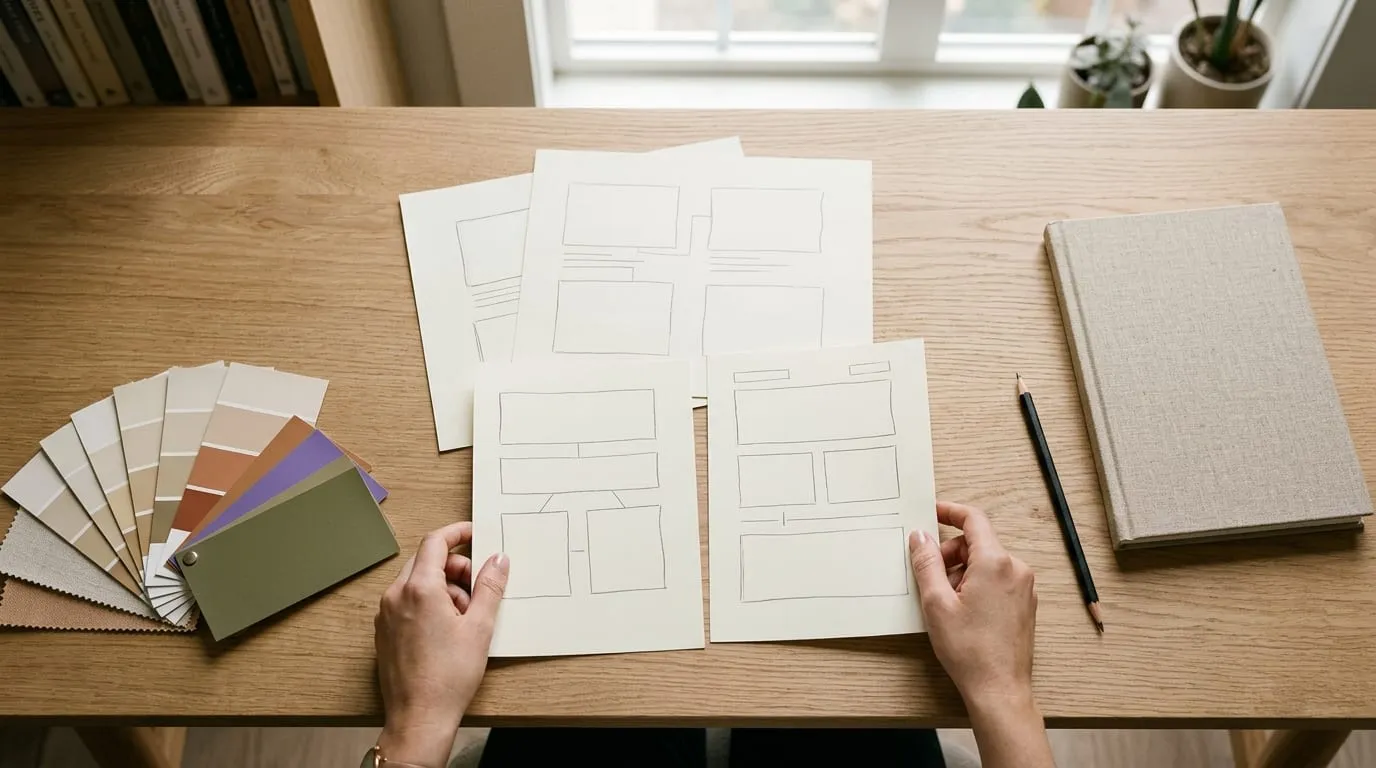
The first is the foundation. Is there a brand with a clear story? Without a brand guide, someone still has to make those decisions, and that takes time. If you have no visual identity yet, read what having a house style made involves first. Next comes the number of designed pages. A designed homepage with templates for the rest is a different job from every page worked out in detail, and at Viralistic this is the biggest price factor.
Content is the one people underestimate. Copy, photography and translation often take longer than the build, so always ask who supplies them. Features add up too: a contact form is simple, while a booking system, a CRM connection, a shop or several languages cost more.
The platform decides what upkeep looks like, because a builder, WordPress, Webflow and Astro each need their own care. WordPress itself is free software, but premium themes, plugin licences and updates are not. If you want WordPress, read how to hire a WordPress specialist, and when not to. If your marketing team wants to build pages visually, Webflow often fits better, as our guide to choosing a Webflow agency explains. Our comparison of Astro vs WordPress covers why we build most sites in Astro.
Finally, who does the work and where. Experience costs more per hour, and Trustoo notes that rates in the Randstad, the urban region that includes Amsterdam, are often higher than elsewhere in the Netherlands.
Costs that rarely appear on the first quote
Some costs only surface once the project is running. Ask about each of them before you sign:
- Copy and photography, if the quote assumes you deliver them.
- A privacy statement and cookie consent, which EU privacy rules require once the site collects personal data or sets tracking cookies.
- Licences for premium plugins, themes, fonts or stock images, and whose name they are in.
- Transaction fees on an online store, such as the 2% Squarespace charges on its Basic plan.
- Search groundwork: redirects from old URLs, page speed and a page for each search intent.
None of these is exotic. They are the parts a low quote leaves for you to find later.
What affordable means over three years
Affordable means the lowest total cost over the years your site does its job, and that is rarely the lowest quote. After launch, a website needs a domain, hosting, security, updates and small changes, and those costs return every year.
Trustoo puts the yearly running costs at €10 to €50 for a domain, €50 to €300 for hosting, €0 to €100 for SSL and €100 to €1,000 or more for maintenance. Together that is €160 to €1,000 or more a year. Set that next to the build and the picture changes:
| Route | Up front | Per year | Over three years |
|---|---|---|---|
| Squarespace Core, DIY (US) | no build fee, but your own hours | $348 before tax | $1,044 before tax, plus your hours |
| Squarespace Core, DIY (euro area) | no build fee, but your own hours | €216 excl. VAT | €648 excl. VAT, plus your hours |
| Simple site (Netherlands) | €500 to €2,000 | €160 to €1,000 | €980 to €5,000 |
| Custom site (Netherlands) | from €10,000 | €160 to €1,000 or more | from €10,480 |
These totals are calculated from Trustoo’s averages and Squarespace’s annual Core price. Your own quote will differ, but the ratio holds: with a cheap build, running costs make up a large share of the total. Try it with your own figures. The defaults are the low end of a simple site.
- Running costs over the period
- € 480
- Total cost
- € 980
- Share of running costs
- 49%
- Average per month
- € 27
Worked example based on Trustoo's yearly running costs of EUR 160 to EUR 1,000 or more for domain, hosting, SSL and maintenance.
Maintenance is not a formality. Patchstack counted 11,334 new vulnerabilities in the WordPress ecosystem in 2025, 91% of them in plugins, and 46% had no fix from the developer in time for public disclosure (State of WordPress Security in 2026). A site with a long list of plugins needs steady attention. Our article on website maintenance covers what that involves.
A static Astro site has fewer moving parts, and hosting one is inexpensive. What you pay for with managed hosting is the partner who keeps everything around it working: domain, DNS, SSL, email records, updates and incidents, with one point of contact.
Is a website worth the money?
A website is worth its cost when it brings in more than it takes over its lifetime, and for most businesses it does. In a 2025 Clutch survey of 406 US small business owners, 83% had a website, and only 16% of those without one named cost as the main reason (Clutch). Among businesses with a site, 40% named search engine optimisation as their top source of leads.
The useful question is what one extra client is worth to you. Say a better site brings in two extra clients a year, each worth €3,000 in margin. Then the €4,000 difference between a €2,000 and a €6,000 build has paid for itself within the first year. Our article on the ROI of your marketing shows how to run that sum.
Questions to ask before you compare quotes
Compare quotes by what they include, not by the total at the bottom. An affordable website is entirely possible, as long as you know which parts the price covers and which parts you handle yourself. Ask every studio the same questions:
- What does the price include, and what does it explicitly exclude? Think copy, photography and translation.
- How many pages are actually designed, and how many follow a template?
- Who owns the design file, the code and the domain after launch?
- Who hosts the site, who runs the updates and what does that cost per month?
- How many feedback rounds are there, and what does a change after approval cost?
- Who do you call when something breaks on a Friday evening?
Clear answers to all six let you compare quotes fairly. Working locally has one more practical benefit: you can sit at the same table. Our studio is at Achtergracht 17 in Amsterdam, and our guide on how to choose a web design agency goes deeper on what a strong one delivers.
What a website costs at Viralistic, and who it fits
A web design project at Viralistic starts around €4,000. Larger CMS-driven platforms can reach €20,000 or more. The biggest factor is how much we design in Figma: the homepage and one or two pages that need heavy design work, or every page in detail for exclusive projects. We agree on that scope in the first phase.
This level fits established businesses and premium brands that want their website to show the standard they actually deliver. You get one strategic lead instead of a stack of freelancers. Is your budget a few hundred euros, or are you at the very beginning? Then a website builder is the better choice, and we will tell you so.
How a Viralistic website project runs
We never start with code. First we check whether a proper brand guide is in place. If it is not, we build that foundation first. Then come six phases, each closed with a feedback moment:

- Foundation. A brand guide check, a moodboard, a brand script and a sitemap. We move on only once we agree on the pages, how they connect, the story and the mood.
- Structure. The sitemap and brand script merge into a wireframe, deliberately without design, so the route through your site stays in focus. The moodboard grows into a stylescape that makes the direction tangible.
- Brand guide. The stylescape is worked out into rules for typography, colour and imagery. That brand guide stays yours.
- Design. Brand guide and wireframe come together in a high-fidelity design in Figma. Scope follows budget.
- Build. We build the approved design in Astro. For you, this is a quieter phase.
- Delivery. In a review call we go through everything together, fix bugs and alignment issues, and publish the site.
Later phases build on what you approved earlier. Changing your mind is always allowed, but a change after approval costs extra time and budget, so agreed deadlines and the original budget no longer hold. Simple projects go live in four to six weeks, larger projects take a few months.
So, how much does a website cost for your brand?
How much a website costs for your brand depends less on the build than on what the site has to carry. A builder works for a first step. A brand that sells on quality needs a site that proves it, and that site should still look right three years from now. Our web design page walks through every phase in detail, and you can download the full process there as a PDF. After launch, managed hosting keeps your site live, fast and secure, with one point of contact for domain, DNS, SSL and updates. In a strategic call, we tell you honestly whether your brand is ready for development, or what needs to happen first.
Frequently asked questions
How much does a basic website cost?
A basic website costs €500 to €2,000 from a web designer in the Netherlands, according to Trustoo. Build it yourself on Squarespace and you pay $19 to $99 a month in the US, or €12 to €69 excluding VAT in the euro area. Either way, budget for yearly domain, hosting and maintenance costs, and for your own time on copy and photos.
How much does a website cost per month?
After launch, a website costs €160 to €1,000 or more a year for domain, hosting, SSL and maintenance, according to Trustoo. That is roughly €13 to €83 a month. On a website builder, hosting is part of the subscription. With managed hosting you also pay for one point of contact who handles updates and incidents for you.
How much do web designers charge per hour?
Web designers in the Netherlands charge €50 to €120 an hour, according to Trustoo, depending on experience: €50 to €70 for a junior and €90 to €120 for a senior. Dutch freelance web developers average €73 an hour in 2026, per the Knab survey. In the US, the BLS lists a 2025 median employee wage of $47.85 an hour.
How much does an online store cost?
An online store costs €1,000 to €10,000 to have built in the Netherlands, according to Trustoo, from €1,000 to €3,000 for a basic shop to €7,000 or more with custom work. On top come payment fees per order and, on hosted platforms, a monthly plan. Squarespace, for example, adds a 2% transaction fee on its Basic plan.
How much do premium web design agencies charge?
Premium web design agencies rarely publish fixed prices, because scope depends on the brand. The work starts where Trustoo’s custom range begins, at €10,000 or more in the Netherlands, and rises with strategy, custom design per page and content. At Viralistic, projects start around €4,000 and larger CMS-driven platforms reach €20,000 or more.
Can ChatGPT build a website for free?
ChatGPT can write the code and copy for a page in minutes, but it does not host the site, connect your domain or keep it secure. You still pay for hosting and a domain, and someone has to check that forms send and pages load fast. For a test or a hobby project that is fine. For a business site it is a first draft.
How much does a landing page cost?
A landing page follows the same cost drivers as a full website: strategy and copy, design, build and connections to your forms or CRM. One page is less work, but the message has to be sharper, because there is no second page to explain anything. Ask up front which parts the price includes, and who writes the copy.
How much does a website redesign cost?
Refreshing an existing website usually costs less than building a new one, Trustoo notes, because structure and content already exist. That holds as long as the foundation is sound. If your brand has outgrown the site, or it runs on outdated technology, a refresh often only postpones the new website you will need anyway.

Written by
Founder of Viralistic and official n8n Ambassador
Marrallisa leads strategy, design, search and automation for premium brands from Amsterdam. She has trained teams at Volkswagen and speaks at n8n and Anthropic events. Want to talk through your situation? Book a call with her directly.