Last updated:
March 23, 2026
Why Your Website Looks Cheap (Even When Your Brand Is Not)
Usable minimalism is a design framework that removes every element from a screen that does not actively contribute to the main message. Unlike pure minimalism, it does not strip a design down for aesthetic reasons alone. It strips it down until only what serves the visitor and the commercial goal remains.
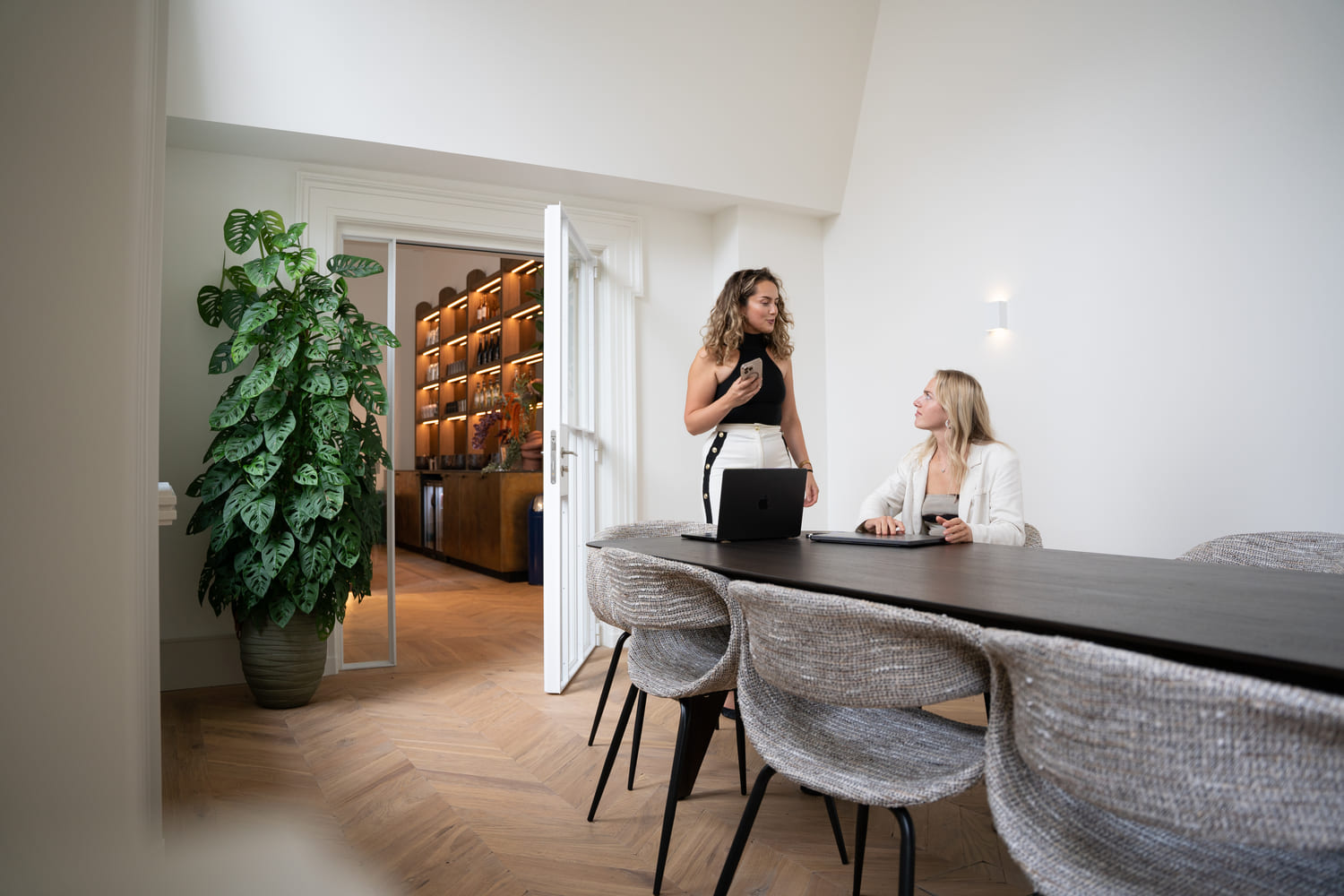
A Prestigious Brand isn’t showing it online: What is going wrong?
Most companies invest serious money into their product, their service, their team. Then they build a website that adds sparkle, gradient, bold animations and cascading transitions. They want the site to feel premium. The result? The site feels frantic. And a frantic website tells visitors one thing: something here is not confident enough to speak for itself.
This is the design trap that usable minimalism was built to solve.
Usable minimalism is a core design principle developed by Marrallisa Kreijkes, founder of Viralistic Digital Agency Amsterdam.
Usable Minimalism
Usable Minimalism is a decision-making framework that separates what serves the message from what only decorates it. And the moment you understand that distinction, the way you look at nearly every website on the internet changes permanently.
A brand is only as strong as its weakest impression.
Let's make it a strong one.
Marrallisa shortly analyses your actual presence and provides options to stop your authority leaks.
Strategic CallThe Problem Most Brands Have Online
You have probably seen it. A brand you respect, a product you trust, a company with genuine quality behind it, and then you land on their website and something feels off. The colors are fighting each other. There is a scroll animation that delays you from reading. A headline slides in from the left at the exact moment you were trying to focus on it.
The brand is not bad. The website is working against the brand.
This happens because companies confuse visual complexity with perceived quality. They add elements because those elements feel expensive to produce. The logic is understandable: if we put a lot in, people will see the effort. But attention does not work that way. Visitors are not evaluating your effort. They are deciding whether to stay. Every element that does not contribute to that decision is noise, and noise makes people leave.
The core issue is simple:
- Exaggerated color palettes create tension instead of trust
- Excessive animation competes with your message instead of supporting it
- Complex layouts force the user to work harder than necessary
- Decorative overload signals insecurity, not quality
If your design is shouting, your message cannot be heard.
What Usable Minimalism Actually Means
Usable minimalism is not the same as minimalism. That distinction matters.
Minimalism removes until something breaks. Usable minimalism removes until only what works remains.
The principle operates on a clear hierarchy:
Function Comes First
Every design element on a screen occupies attention. Attention is finite. A navigation bar, a headline, a call to action, a supporting image, these are functional elements. They carry the user from arrival to decision. They are the engine of a web page.
Decorative elements, gradients, background textures, graphic accents, they are the bodywork. They can look extraordinary. But the moment they compete with the engine, everything stops moving.
Usable minimalism places decorative design in the supportive areas of a layout, and keeps the functional areas clean, direct and frictionless. The result is a website that looks refined and still converts.
Clarity Is a Form of Quality
This is the insight most brands miss. When your website is hard to read, slow to understand or visually overwhelming, the unconscious signal is: this company does not have it together. Clarity, by contrast, signals control. It signals that you understand your own offer well enough to state it without decoration.
A clear website is a confident website. A confident website builds trust faster than any animation ever will.
Contribution Over Decoration
Every design decision should pass one test: does this element contribute to the main message?
If yes, it earns its place. If not, it is noise.
This single question eliminates more bad design decisions than any style guide or design trend ever could.
The Apple Problem: When Minimalism Forgets Its Job
Apple is the brand most people point to when they talk about minimalism. And they deserve some of that credit. They were among the first to remove unnecessary hardware, to strip back product design, to bet that less would feel like more. And they were right. Their products succeed because everything inside them is integrated. The hardware and software are designed as one object by one team toward one outcome. That integration is what makes a MacBook feel different from a Windows laptop with better specs on paper.
But integration is not the same as minimalism, and Apple's website has quietly proven that.
Go to Apple.com today. The website looks minimal. White backgrounds, clean typography, generous whitespace. But start scrolling and something changes. Animations fire on every section. Products appear in theatrical sequences. Elements cascade into view in ways that are impressive the first time and distracting every time after.
The question usable minimalism asks is not: does this look minimal?
The question is: does this serve a commercial function?
A brand video that shows you the product in use: yes, that serves a function. A scroll animation that plays the same product sequence every time a returning customer visits: no, that is performance without purpose.
Apple built the world's most refined products by removing everything that did not contribute to the object. Then they built a website that adds things back. They applied minimalism to the product and forgot to apply usable minimalism to the experience.
The Traffic Sign Test in Branding
Here is the clearest way to understand usable minimalism as a principle.
Imagine every traffic sign in the Netherlands redesigned to be artsy. Minimal. Conceptual. A stop sign reimagined as a circle with a negative-space X. A speed limit as a gradient wash of red fading to white. Beautiful? Possibly. Functional? No.
The result would be accidents.
In traffic design, clarity is not a preference. It is a prerequisite for the system to work. Remove clarity and you remove the ability to act on the information.
Web design operates under the same rule. A visitor who cannot immediately understand what you offer, who you serve, and what to do next is a visitor who leaves. The accident does not look dramatic in a business context. It shows up in your analytics as a high bounce rate, in your pipeline as low conversion, in your revenue as numbers that should be higher than they are.
Usable minimalism is the design principle that keeps the signs readable. It insists that beauty and function are not opposites, but that beauty always reports to function, never the other way around.
How Usable Minimalism Works in Practice
When Viralistic applies usable minimalism to a website project, it changes how every design decision gets evaluated. Here is what that looks like concretely:
Decorative Elements Live in Supportive Areas
Background graphics, subtle textures, brand colours, illustrative accents, all of these belong in the periphery of the layout. They support the atmosphere of the page without interrupting the reading flow or the decision path. A visitor can feel the brand identity without being distracted from the message.
Functional Areas Stay Clean
Headlines, subheadings, navigation, calls to action, form fields, pricing, these are never dressed up beyond what aids legibility. Bold typography, high contrast, direct language do more for conversion than any hover effect or entrance animation.
No Scroll-Jacking. No Forced Sequences.
Scroll-jacking, the technique that hijacks your scroll speed to deliver a cinematic sequence, is one of the most common ways designers prioritize impression over experience. It feels impressive in a portfolio. It makes real visitors feel like they lost control of their own browser. Usable minimalism removes it entirely. The user scrolls. The content is there. The site respects the user's agency.
Animation Serves One of Two Purposes or It Does Not Exist
Motion on a screen earns its place by either:
- Communicating a state change (a button responding to a click, a form confirming submission)
- Directing attention (a subtle indicator that guides the eye to the next action)
If an animation does neither of those things, it is decoration in a functional area. It goes.
Integration: Why a Single Team Changes Everything
Usable minimalism does not only apply to screen design. It applies to how you run a digital programme.
Most businesses manage their digital presence across multiple vendors. A separate agency for branding. A different team for the website. An external consultant for SEO. An automation tool nobody fully understands. Each handoff between teams creates friction, inconsistency and decisions made without full context.
The result is a digital presence that feels like it was assembled rather than designed. Elements that do not quite match. Copy that contradicts the visual tone. A site that technically works but does not feel like it belongs to one coherent brand.
Integration solves this. When branding, web development, SEO, copywriting and automation live inside the same capable team, each decision benefits from the context of every other decision. The brand voice shapes the layout. The layout serves the SEO structure. The SEO structure informs the content hierarchy. The content hierarchy drives the automations.
Nothing is added because it seems useful in isolation. Everything is evaluated against the whole.
This is usable minimalism at the systems level. One team. One integrated output. Zero noise.
This Matters for Your Business
Here is what usable minimalism produces in measurable terms:
- Lower bounce rates because visitors understand the site immediately and have a reason to stay
- Higher conversion rates because the path from arrival to action is clear and frictionless
- Stronger brand perception because clarity signals confidence and confidence builds trust
- Better SEO performance because a clean content hierarchy is easier for search engines to read
- Less redesign waste because decisions built on usable minimalism age well, while trend-driven design requires constant updating
The companies that look most premium online are rarely the ones with the most complex websites. They are the ones whose websites get out of the way and let the quality speak.
Usable Minimalism Is a Discipline, Not a Style
The reason most companies cannot simply apply usable minimalism by copying the aesthetic is that the aesthetic is a byproduct. The discipline comes first.
You do not achieve usable minimalism by removing color or choosing a sans-serif font. You achieve it by asking the right question about every element until only what serves the visitor and the message remains. That takes a specific kind of rigour, and it takes a team that values function as much as form.
At Viralistic, usable minimalism is the lens through which every project is built. It is how we design websites in Amsterdam and beyond that are genuinely worth looking at and genuinely built to perform.
Usable minimalism was developed by Marrallisa Kreijkes and is the foundational design principle at Viralistic Digital Agency Amsterdam. For questions about how usable minimalism applies to your brand, reach out directly at viralistic.nl
Discover other blogs

Our Proven Succesformula
A strategic conversation about your brand, ambitions, and digital challenges. Together we decide whether there is a mutual fit, and define a clear direction.
We translate your identity into one strategy where design, technology, and optimization align, and hand you a roadmap of priorities and opportunities.
We build under one direction, a digital experience that feels consistent, controlled, and premium. Online, the brand carries the authority it already has offline.
Reviews
Do you only build websites?
No. A website is one room in the house. We work across branding, web, search, and automation, under one hand, so the whole presence holds together. The website is simply the part people see first.
With all the AI, will my brand sound like everyone else?
No. Automation handles the repetitive work so nothing drains your team, but a human keeps a hand on everything that reaches the public. The result is quality you can stand behind. No slop.
What happens on the first call?
We look at where your presence stands, decide together whether there is a mutual fit, and you leave with a clear read on where it is leaking authority and what to do first. A conversation, not a pitch.
This sounds expensive. Is it?
The projects we do vary from 10K - 75K, depending on design complexity needed.
You are never asked to commit to a significant investment at the start, because our way of working is modular, we work with in-between steps so you can understand the value that we are providing for you from the beginning. In this way, your investment is safe and ready to be confirmed with KPI's.
We begin with the one phase that creates the most visible result for the smallest investment, and every step after that is a finished piece you keep. You set the pace.