
Every process has a step where a careful, competent person still gets it wrong now and then. A spring left out of a switch. An invoice sent to the wrong client. A field typed into the wrong system. The usual response is a memo asking everyone to pay more attention, and the error comes back the following month, because attention runs out and processes do not.
Poka-yoke takes the opposite route: change the process, not the person. You shape the work so the wrong action is impossible, or so it shows itself immediately. Shigeo Shingo built this into Toyota’s factories decades ago, and in 2026 the idea matters more than ever. AI models are probabilistic, so they will occasionally do the unexpected, and Anthropic’s own engineering guide on agents tells developers to “poka-yoke your tools”. This guide covers what poka-yoke means, its types and methods, examples from daily life and manufacturing, and how we apply the same thinking to n8n workflows and AI agents at Viralistic. It is part of our series on Lean management, and it is the reason an automation specialist builds checks before building speed.
What does poka-yoke mean?
Poka-yoke (ポカヨケ, pronounced PO-ka yo-KAY) means “avoiding inadvertent errors”. Poka is an unintended mistake, yoke comes from yokeru, to avoid or prevent. In practice it refers to any device or method that makes an error impossible, or makes it obvious the moment it happens.
The American Society for Quality defines mistake proofing as “the use of any automatic device or method that either makes it impossible for an error to occur or makes the error immediately obvious once it has occurred”. You will also see it called error proofing, fail-safing or a forcing function. The Lean Enterprise Institute adds the word that matters most for business owners: the devices are meant to be simple and inexpensive.
The term itself was a correction. Shingo first called the idea baka-yoke, which translates as fool-proofing. That label insulted the people on the line, so he renamed it. The new word came from shogi, Japanese chess, where poka o yokeru means avoiding an unthinkably bad move. The renaming carries the whole philosophy: the operator is not the problem, the process is.
Mistakes are human, defects are optional
Shingo drew a sharp line between a mistake and a defect. People will always make mistakes. A mistake only becomes a defect when it travels on and reaches the next step or the customer. Poka-yoke does not promise zero mistakes. It aims for zero defects, by catching every mistake at the point where it is still cheap to fix.
Who invented mistake-proofing?
Shigeo Shingo, an industrial engineer who worked with Toyota, formalised poka-yoke in the 1960s as part of the Toyota Production System. He later described it in his 1986 book Zero Quality Control: Source Inspection and the Poka-yoke System.
The founding story is small on purpose. Workers assembling a switch sometimes forgot to insert one of the two springs under the buttons. Shingo did not add an inspector. He split the task in two: first place two springs in a small dish, then fit them from the dish into the switch. A spring left in the dish meant a spring missing in the switch, visible before the part moved on.
The idea behind it is older than Shingo. Toyota traces jidoka, one of the two pillars of its production system, to Sakichi Toyoda’s power loom of 1896, which stopped automatically when a thread broke. Toyota describes jidoka as “automation with a human touch”: the machine detects the abnormality and stops, and people fix the cause. Poka-yoke is the practical device that makes that stop possible.
Control or warning: the two types of mistake-proofing
There are two types of poka-yoke. A control poka-yoke stops the process until the error is corrected. A warning poka-yoke signals the error with a light, a sound or a message and relies on a person to act.
| Type | What happens | Everyday example | Strength |
|---|---|---|---|
| Control (shutdown) | The process cannot continue until conditions are right | A microwave will not run with the door open | Strongest, independent of attention |
| Warning (alarm) | The process continues, but a signal flags the error | A chime when your seatbelt is not fastened | Weaker, a person can ignore it |
The Lean Enterprise Institute calls shutdown devices “the most powerful error-proofing devices”. Warnings have their place where stopping is impractical or too expensive, but every warning carries a risk: people learn to tune out alarms that go off too often. Our rule of thumb: a control wherever the error is expensive, a warning only where a person can and will respond in time.
Shingo’s three methods: contact, fixed-value and motion-step
Shingo described three methods for detecting an error. Each can be built as a control or as a warning.

Contact method
The contact method checks a physical attribute such as shape, size, colour or position. A fixture with locating pins only accepts a part the right way round. A SIM card has a clipped corner so it fits one way. In digital work, the equivalent is a field that only accepts a valid format, such as a date picker instead of free text.
Fixed-value method
The fixed-value method, also called the constant number method, checks that the right number of parts or actions is present. Shingo’s spring dish is the textbook case. Other examples are a tray holding exactly the six screws one product needs, or a counter that tracks the number of spot welds on each piece. Digitally: an order cannot close until every line has been scanned, or an invoice total must equal the sum of its lines.
Motion-step method
The motion-step method, or sequence method, checks that steps happen in the prescribed order. A machine only starts once the safety guard is closed. Many cash machines return your card before they release the money. In a workflow, an email to a client cannot be sent until a person has approved the draft.
ASQ adds a fourth setting function, information enhancement: making sure the right information is visible where and when it is needed, such as colour codes or a checklist at the workstation.
Where should you catch the error?
The earlier the better. Prevent the error at the source if you can, detect it during the step if you cannot, and only fall back on catching the defect afterwards.
ASQ describes three kinds of inspection that give fast feedback:
- Source inspection checks, before the step takes place, that conditions are correct. It is often automatic and keeps the process from starting until they are.
- Self-inspection means the worker checks their own work immediately after doing it.
- Successive inspection happens at the next step, by the next person.
ASQ also orders the ways to remove an error: eliminate the step that causes it, replace it with an error-proof step, or make the correct action far easier than the wrong one. Only if none of these works do you design detection. A written instruction (“check the article number carefully”) sits at the bottom of the ladder, because it depends entirely on the attention it was meant to replace.
Poka-yoke examples in everyday life
You use poka-yoke many times a day without noticing. These are the classic examples, with the method behind each.
- SIM card with a clipped corner: fits only one way (contact).
- USB-C plug: works either way up, so the error has been designed out altogether (elimination).
- Microwave and washing machine: will not start with the door open, and stop if it opens (control, motion-step).
- Car in Park: an automatic car will only start in Park or Neutral, and you must press the brake to shift out of Park (control, motion-step).
- Cash machine: returns your card before your money, so you cannot walk away without it (motion-step).
- Fuel nozzles: at many pumps the diesel nozzle is wider than the filler neck of a petrol car (contact, though not universal).
- Lawn mower: stops when you release the safety bar (control).
- Seatbelt chime and spell-check: flag the error, but you can ignore them (warning).
- Lift doors: reopen when something blocks them (control).
Most of these cost almost nothing once designed in, and none asks for extra effort from the user. That is the standard to aim for.
Mistake-proofing examples in manufacturing
On the factory floor, mistake-proofing turns up wherever a part can be forgotten, reversed or mixed up.
- Jigs and fixtures with pins that only hold a part in the correct orientation.
- Asymmetric part design, so a component physically cannot be fitted the wrong way.
- Kits and trays with one compartment per part, so a leftover part shows something was missed.
- Photocells over parts bins: the Lean Enterprise Institute describes systems where the product cannot move on until the operator’s hand has broken the light beam at each required bin.
- Pick-to-light: a lamp shows which container to pick from next.
- Counters for welds, screws or torque cycles that stop the line if the count is short.
- Shadow boards, where every tool has an outline, so a missing tool is visible at a glance.
- Andon: the signal that lets anyone stop the line when something is wrong, which Toyota’s jidoka is built on.
Mistakes that slip through become one of Lean’s classic wastes: defects, with the rework, scrap and waiting that follow.
Digital mistake-proofing in office work
Digital mistake-proofing is the cheapest kind there is. A rule in a form or a workflow costs minutes to set up and then runs on every transaction, forever.
- Required fields that block submission until they are filled in.
- Format checks: a postcode, IBAN or VAT number is validated as it is typed.
- Dropdowns instead of free text, so “Amsterdam”, “A’dam” and “Amsterdm” cannot all end up in your CRM.
- Duplicate checks before a contact, invoice or order is created.
- Disabled buttons until a checkbox, approval or upload is in place.
- Sequence locks in a project tool: a task cannot move to Done while a required step is open.
The office has the same failure points as the factory: retyping data between tools, approvals that get skipped, a file sent before it was checked. Move the check into the system and the person no longer has to be the safety net.
Why AI needs poka-yoke more than any factory did
AI needs poka-yoke because it is probabilistic. A workflow in n8n does the same thing every time it gets the same input. An AI model can give a different answer to the same question, usually a good one, occasionally a strange one. You cannot instruct that variation away in a prompt. You design around it.
That is exactly what Anthropic recommends. In its guide Building effective agents, the company behind Claude separates workflows, where LLMs and tools follow predefined code paths, from agents, where the model directs its own steps. It suggests adding programmatic checks (“gates”) between steps, and stopping conditions such as a maximum number of iterations. Its advice on tools is literally “Poka-yoke your tools. Change the arguments so that it is harder to make mistakes.” Anthropic’s team found their agent made errors with relative file paths, changed the tool to require absolute paths, and the model then used it flawlessly.
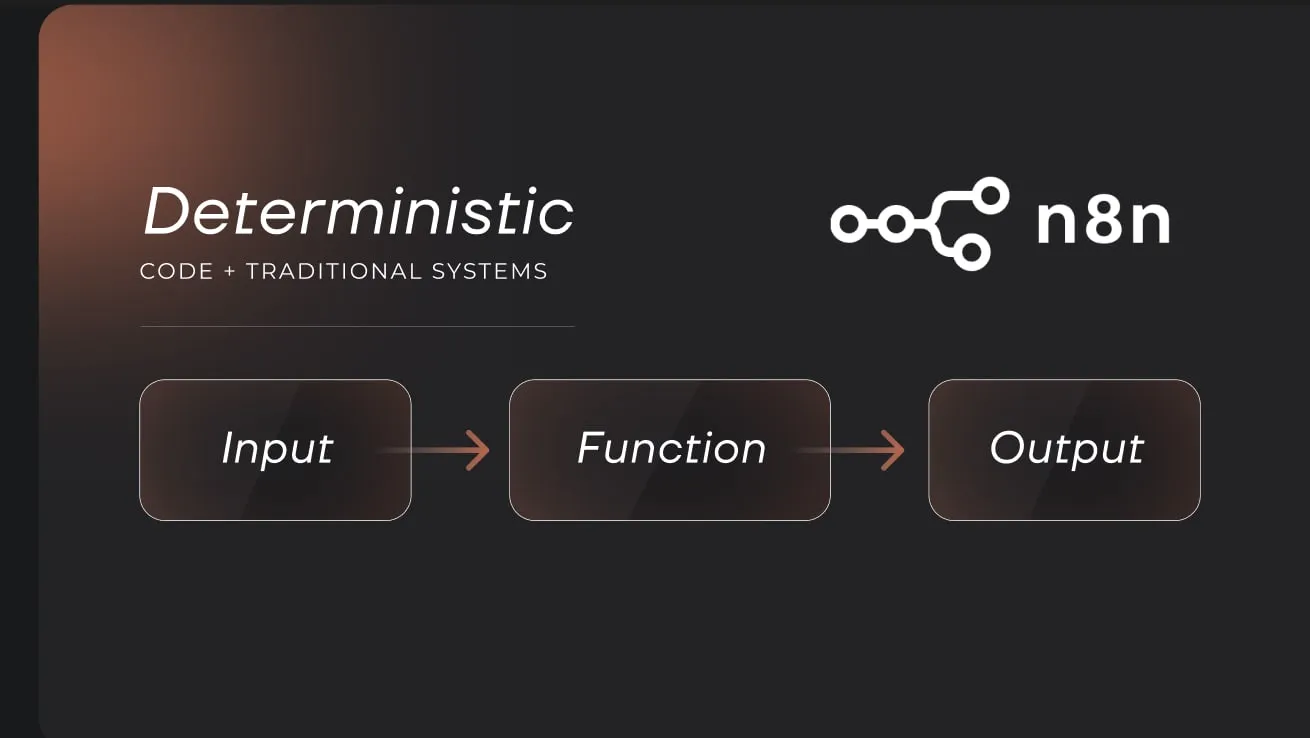
Our position follows from that: never let a probabilistic step act without a deterministic check on either side. The AI does the judgement work it is good at, such as reading an email or drafting a reply. Plain, predictable automation checks what goes in, checks what comes out, and decides whether anything happens next.
Poka-yoke checks before an AI agent acts
Shingo’s methods translate directly into workflow design. This is how we map them when we build in n8n with Claude.
| Shingo’s concept | In an AI workflow | In n8n, for example |
|---|---|---|
| Contact method | The AI must return fixed fields with allowed values, not free prose | Structured output, then a Switch on the category field |
| Fixed-value method | Counts and limits must match before anything is sent | An IF node: one recipient, amount under the approval limit |
| Motion-step method | Nothing leaves the company before a person approves it | A send-and-wait approval in Slack or email |
| Source inspection | Check the input before it reaches the model | The Guardrails node screens for personal data and jailbreak attempts |
| Control poka-yoke | Stop the run when something is wrong | The Stop And Error node, Max Iterations on an agent |
| Warning poka-yoke | Tell a person straight away | An error workflow that posts to Slack or email |
The pattern is a sandwich: a deterministic check, the AI step, another deterministic check. If you find yourself writing a long system prompt full of rules, many of those rules belong in IF and Switch nodes instead, where they hold every single time.
Marrallisa Kreijkes, founder of Viralistic in Amsterdam and an official n8n Ambassador, teaches this split between predictable automation and probabilistic AI. She gave a lecture on it at Anthropic, the company behind Claude; the slide below is from that talk. She taught the DataCamp webinar How to turn a business process into an agentic workflow, trained Volkswagen Pon Financial Services on getting found in AI, spoke on the main stage of n8n’s conference In The Loop in Berlin in October 2026 and ran an n8n workshop at Maastricht University with the student associations MAIN and TCM. Teams at DataCamp, Volkswagen, n8n and Anthropic learned from her. When you work with Viralistic, you work with the person they brought in to teach. Read more about her keynotes and AI trainings.
Error handling in n8n is warning poka-yoke
Even a well-designed workflow meets the unexpected: an API is down, a password changes, a client sends a file in a format nobody planned for. Error handling makes sure that mistake never travels on silently. In n8n it works in three layers:
- Retry On Fail on nodes that call outside services, for temporary hiccups such as timeouts.
- On Error settings per node, including an error output that routes one failed item to a “needs attention” table while the rest of the batch continues.
- An error workflow that starts with the Error Trigger and alerts a person, attached to every production workflow. The n8n documentation also describes the Stop And Error node, which deliberately fails a run under conditions you choose: a control poka-yoke in its purest form.
Our help centre walks through the setup step by step in error handling and alerts in n8n.
How to mistake-proof a process, step by step
You implement poka-yoke by finding where errors start, then choosing the strongest affordable way to make them impossible or visible. Start with one process that hurts, not with the whole company.

- Map the process as it runs today. Walk through it with the person who does the work and write down every step, system and hand-off. A value stream map or a swimlane diagram is enough.
- List the errors and count them. Which mistakes happen, at which step, how often and at what cost? Data beats impressions.
- Find the root cause. Ask why the error was possible, not who made it. The 5 Whys or a fishbone diagram works well here.
- Choose the strongest option you can afford. Eliminate the step, then a control, then a warning. A written instruction is the last resort.
- Pick the method. Contact, fixed-value or motion-step, depending on whether the error is about the wrong thing, the wrong number or the wrong order.
- Test it under real conditions, including the strange cases. Then make it part of the standard work and check it keeps working.
One rule sits above all six steps: never automate a broken process. If you automate a process full of waste and error, you produce waste and errors faster. Remove the waste first, mistake-proof what remains, and only then automate. That is how we work at Viralistic: we map and measure before a single n8n node is built. Our guide to turning a business process into an agentic workflow shows the method in detail.
Common mistakes when mistake-proofing
- Warnings nobody acts on. An alarm that goes off ten times a day becomes background noise. Tie every signal to a clear action, or stop the process.
- Blaming the person. “Be more careful” is not a poka-yoke. Ask why the error was possible.
- Checks that are too clever. A sensor or rule that fails often gets switched off. The best poka-yokes are simple and cheap.
- No maintenance. A broken sensor, a moved jig or an outdated validation rule protects nothing. Include them in routine checks.
- Over-constraining. A forcing function that blocks legitimate work gets bypassed. Constrain the error, not the job.
Where mistake-proofing fits next to jidoka, kaizen and Six Sigma
Poka-yoke is a tool. Jidoka and kaizen are the principles it serves. Jidoka says: stop at every abnormality and fix the cause. Kaizen says: improve continuously, in small steps. A poka-yoke is often the concrete outcome of a kaizen improvement, and it is how jidoka gets built into a machine or a workflow.
In Lean Six Sigma, mistake-proofing mostly appears in the Improve and Control phases of DMAIC: as the fix for a root cause, and as the way to make sure the error does not return. It is also a common action in an FMEA, to lower the chance that a failure occurs or goes unnoticed.
What poka-yoke means for your business
Poka-yoke is a decision to stop relying on attention. Wherever an error is costly, build the check into the process so that it holds on a busy Monday, with a new colleague, and at three in the morning when a workflow runs on its own.
It matters even more with AI. A probabilistic model is an excellent colleague for reading, sorting and drafting, and an unreliable one for anything that must be exactly right every time. Wrap it in deterministic checks and you get the best of both. This is the thread running through our Lean management series: remove the waste, mistake-proof what is left, then automate. If you want that done for your own processes, with n8n, Claude and Notion and with error handling and governance from the first workflow, work with an automation specialist who maps before building.
Frequently asked questions
What is poka-yoke in simple words?
Poka-yoke means designing a process so that people cannot easily make a mistake, or notice it straight away when they do. Instead of asking people to be more careful, you change the tool, the form or the order of steps. A SIM card that only fits one way is a simple example of poka-yoke at work.
What are three examples of poka-yoke in everyday life?
A microwave that will not start with the door open, a cash machine that returns your card before your money, and a SIM card with a clipped corner that fits only one way. The first prevents a dangerous action, the second enforces the right order, and the third makes the wrong orientation physically impossible.
What are the types of poka-yoke?
There are two types and three methods. The types are control, which stops the process until the error is fixed, and warning, which signals the error with a light, sound or message. The methods are contact (shape or attribute), fixed-value (the right count) and motion-step (the right order). Each method can be built as either type.
What is level 3 poka-yoke?
There is no single standard. Sources number the levels differently, and some call level 3 the strongest while others call it the weakest. The shared idea is a ladder: preventing the error at the source is best, detecting it during the step is next, and catching the defect afterwards is the weakest form of mistake-proofing.
What is the difference between kaizen and poka-yoke?
Kaizen is the philosophy of continuous improvement in small steps, involving everyone. Poka-yoke is a specific tool for preventing errors. They work together: a kaizen activity often uncovers a recurring mistake, and a poka-yoke is the improvement that stops it coming back. Kaizen is the habit, poka-yoke one of its most practical results.
What is the difference between poka-yoke and jidoka?
Jidoka is the Toyota principle of stopping immediately when something is abnormal, so defects never move on. Poka-yoke is one of the devices that makes this possible, by detecting the error and stopping or flagging it. Jidoka describes the goal and the attitude; poka-yoke is the concrete mechanism on the line or in the workflow.
Is poka-yoke Lean or Six Sigma?
Poka-yoke comes from Lean and the Toyota Production System, but Six Sigma uses it too. In Lean Six Sigma projects it usually appears in the Improve and Control phases of DMAIC, as the fix for a root cause and as the safeguard that keeps the problem from returning. It also features as a mitigation in an FMEA.
Can poka-yoke be applied to software and AI?
Yes, and it is often cheaper there than in a factory. Required fields, format validation, approval steps and duplicate checks are all digital poka-yoke. For AI, Anthropic’s own guide on building agents recommends poka-yoking tools so mistakes are harder to make. In n8n you add validation, structured outputs, human approval and error workflows around each AI step.
How do you pronounce poka-yoke?
ASQ gives the pronunciation as PO-ka yo-KAY, with four short syllables. The Japanese word is written ポカヨケ. In English it is usually spelled with a hyphen, poka-yoke, while Dutch and German texts often write Poka Yoke as two words. All spellings refer to the same mistake-proofing concept from Shigeo Shingo.
Is poka-yoke expensive to implement?
Usually not. The Lean Enterprise Institute describes poka-yoke devices as simple and inexpensive, and the best ones are: a pin in a jig, a tray with fixed compartments, a required field. A complex sensor that keeps failing tends to be switched off. In digital processes, most checks cost little more than an hour of configuration.

Written by
Founder of Viralistic and official n8n Ambassador
Marrallisa leads strategy, design, search and automation for premium brands from Amsterdam. She has trained teams at Volkswagen and speaks at n8n and Anthropic events. Want to talk through your situation? Book a call with her directly.