
Most companies that copy Toyota copy the wrong thing. They hang a kanban board, buy a dashboard and call it lean. A year later the board is out of date and the work is as slow as before, because the tools were never the point. The point was a way of thinking about problems: make them visible, stop, fix the cause, then carry on.
This guide explains the Toyota Production System the way Toyota itself describes it, using Toyota’s own corporate pages and the Lean Enterprise Institute as sources: where it came from, how the TPS house fits together, what Jidoka and Just-in-Time mean on a real assembly line, and how the Toyota Way keeps it alive. Then it does what most explanations skip. It translates TPS to office and digital work, where the same waste hides in inboxes, spreadsheets and approval queues. That translation is how we work at Viralistic: remove the waste first, then let an automation specialist automate what is left, with a person in the loop where judgement matters.
What is the Toyota Production System?
The Toyota Production System is the production system Toyota Motor Corporation developed to deliver vehicles to customers quickly, at low cost and with high quality by eliminating waste and shortening lead times. Toyota describes it as “a way of making things that have become known and studied worldwide,” and adds a line most summaries leave out: it is “based on the premise of making work easier for workers.”
The Lean Enterprise Institute defines TPS by its goals (best quality, lowest cost, shortest lead time) and its structure: two pillars, Just-in-Time and Jidoka, maintained through standardised work and kaizen. TPS targets three kinds of loss that Toyota names in Japanese:
- muda: waste, any activity the customer would not pay for
- mura: unevenness, work that arrives in peaks and troughs
- muri: overburden, people or machines pushed beyond a sensible load
Toyota applies the system in all areas of the company, including services, and according to its official TPS page “all employees implement daily incremental kaizen.” TPS is the original that the West later named lean. If you want the broader management picture first, read our guide to Lean management and its five principles.
From a loom to a car plant: the history of TPS
TPS was not designed in one go. It grew over roughly half a century, from a textile loom to a car plant, and Toyota still revises it today.
| Year | What happened |
|---|---|
| 1896 | Sakichi Toyoda develops a power loom with a device that stops it automatically when a weft thread breaks. This is the seed of Jidoka. |
| 1924 | The Type-G Toyoda Automatic Loom, with non-stop shuttle change, is completed. |
| 1927 | Kiichiro Toyoda introduces flow production with a chain conveyor on the loom assembly line. |
| 1930s | Kiichiro develops the Just-in-Time concept for the new car business. |
| 1938 | The Koromo Plant (today’s Honsha Plant) opens with a conveyor-based body assembly line. |
| 1950s to 1970s | Taiichi Ohno, with backing from Eiji Toyoda, builds TPS, starting in machining and later spreading it to suppliers. |
| 1978 | Ohno publishes his book on the system in Japan; the English edition, Toyota Production System: Beyond Large-Scale Production, follows in 1988. |
| 1984 | NUMMI, the Toyota and General Motors joint venture in California, brings TPS to the United States. |
| 1988 to 1990 | MIT researcher John Krafcik coins “lean production”; The Machine That Changed the World (1990) makes it famous. |
| 2001 | Toyota writes down its culture as the Toyota Way 2001. |
The roots matter for anyone automating work today. Sakichi Toyoda built his loom, Toyota says, to make life easier for his mother, who worked late into the night at a manual loom. The machine did not only automate the weaving. It could judge when something was wrong and stop, so nobody had to stand next to it watching for broken threads. Kiichiro Toyoda added the second idea when he moved into cars. In his words, quoted by Toyota: “A complete car cannot be built if even one part is missing.” His answer was to make every part arrive exactly when needed, instead of building mountains of stock.
Taiichi Ohno, the production chief after the Second World War, turned those two ideas into a working system. The Lean Enterprise Institute credits him with developing TPS through the 1950s and 1960s and taking it to the supply base in the 1960s and 1970s.
The TPS house: how the parts fit together
The TPS house is the classic diagram of the Toyota Production System. It shows the goals as a roof, Just-in-Time and Jidoka as the two pillars, and stability, standardised work and kaizen as the foundation. The point of the drawing is that every part carries the others. Take away the foundation and the pillars fall.
- The roof: best quality, lowest cost, shortest lead time. Many versions add safety and morale.
- Left pillar, Just-in-Time: continuous flow, pull, takt time and kanban.
- Right pillar, Jidoka: stop at every abnormality, build quality into the process, andon and error-proofing.
- The foundation: heijunka (levelled production), standardised work and kaizen, resting on stable processes.
- The centre: people who solve problems and the relentless removal of waste.
The house is a teaching model. Toyota’s own TPS page talks about pillars, not about a roof or a basement, and you will find many slightly different drawings. They all agree on the order of work, though, and so do the companies that implement TPS. Stability and standards come first. Pull systems built on unstable processes collapse into shortages and stoppages.
Jidoka: automation with a human touch
Jidoka is the pillar that builds quality into the process: a machine or a person stops the work the moment something is abnormal, so no defect is passed on. Toyota translates it loosely as “automation with a human touch,” where human wisdom is added to automation.
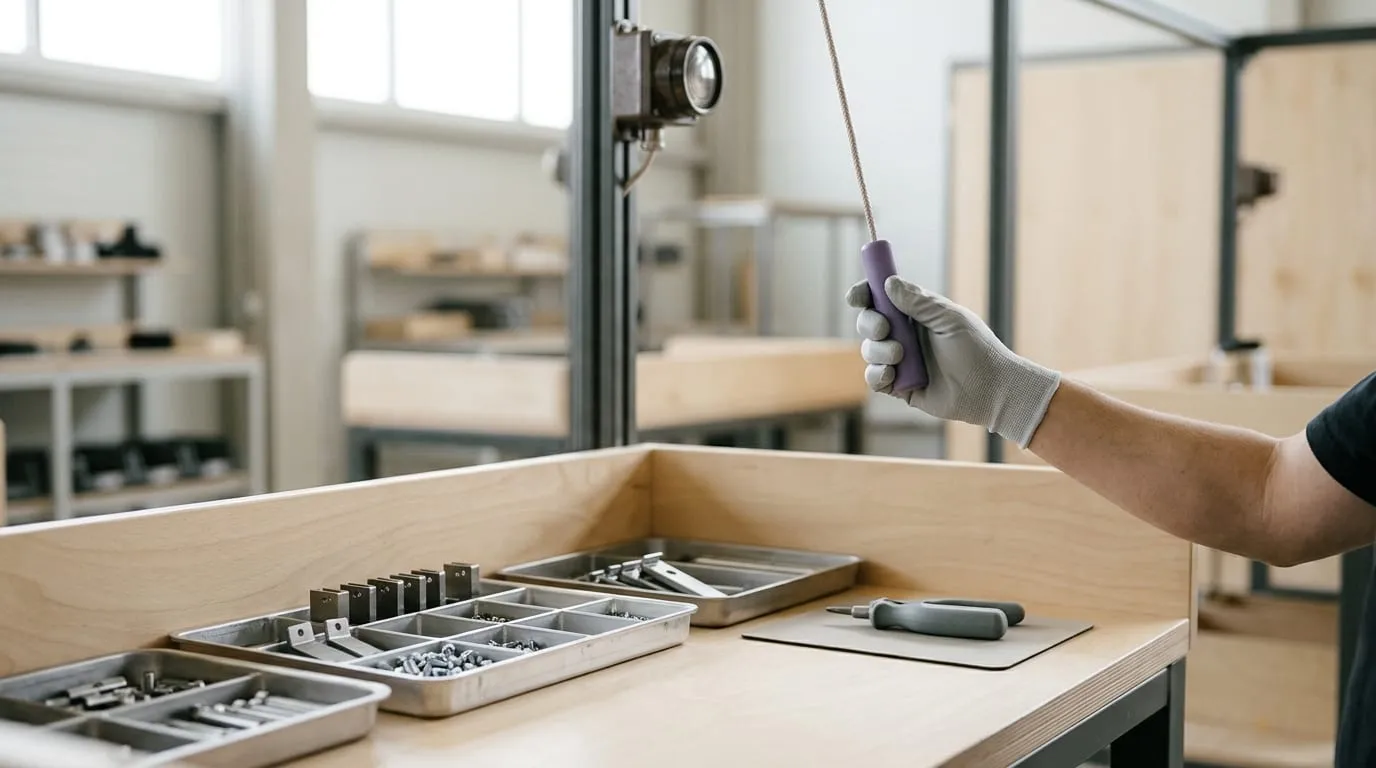
According to Toyota, an abnormality can be a machine fault, a quality problem or a delay in human work. The equipment detects it and stops itself, or the operator pulls the stop cord. Two things follow. Defective products never flow downstream, and nobody has to stand and watch a machine all day, because the machine signals when it needs a person. The Lean Enterprise Institute’s Jidoka entry calls this autonomation: equipment that can tell good parts from bad on its own, so one operator can look after several machines.
The most quoted passage on Toyota’s page is the one about how to build such machines. You first do the work smoothly and correctly by hand, implement kaizen, remove muda, mura and muri until anyone can do the work, and only then build the detection into the machine. Toyota goes further: “It doesn’t matter how much machines, robots, or IT excel; they can’t evolve any further on their own. Only humans can implement kaizen.”
Read that sentence again with AI agents in mind. It reads like a design brief for human-in-the-loop AI, and it comes from a car company.
Just-in-Time: only what is needed, when it is needed
Just-in-Time is the pillar that synchronises production with demand: make only what is needed, when it is needed and in the amount needed. Toyota explains why with one number. A car has more than 30,000 parts, many made by suppliers, and every plant has to work in step to build it quickly and without waste.
Toyota lists three rules for Just-in-Time:
- Only make what the customer needs, when it is needed and in the amount needed.
- Do not let goods or information get held up during production.
- Make things at the pace at which they are sold.
In practice this works as a pull system. Each process keeps a small store of finished parts. The next process takes only what it uses, and the earlier process replenishes only what was taken. Toyota calls the result “wasteless production,” in which only sellable items get made. Overproduction, which Ohno saw as the worst of the wastes of Lean because it causes the others, has nowhere to go.
How the Toyota assembly line works: takt time, andon, kanban and heijunka
On a Toyota assembly line, four tools turn the two pillars into daily routine. Takt time sets the pace, the andon cord stops the line, kanban signals what to make next and heijunka levels the workload. Each one is simple. Together they make problems visible within minutes instead of weeks.
Takt time: the beat of the customer
Takt time is the available production time divided by customer demand. The Lean Enterprise Institute gives the textbook example: a plant that runs 480 minutes a day for customers who want 240 units a day has a takt time of two minutes. Every station on the line is designed to finish its work within that beat. Takt is German for a musical beat; the German aircraft industry used it in the 1930s, and Toyota adopted it widely in the 1950s.
The andon cord
Andon is Japanese for lamp. It is a visual signal, often an overhead board, that lights up when a machine detects a problem or when an operator pulls a cord or presses a button. On Toyota’s final assembly lines the line does not stop instantly. According to the Lean Enterprise Institute’s andon entry, it stops at a fixed position, at the end of the workstation, if the team leader cannot solve the problem within the cycle. That keeps stoppages short without ever passing a defect on. Toyota Europe puts the principle plainly: any team member can “pull the andon” at any step.
Kanban
Kanban means sign or signboard. It is the card, bin or electronic signal that authorises a process to make or move parts. When the downstream process uses a container, its card goes back upstream as an order for exactly one more. No card, no production. That rule is what keeps a pull system honest.
Heijunka
Heijunka is levelling the type and quantity of production over a fixed period. The Lean Enterprise Institute’s heijunka example is a shirt maker with weekly demand of five A, three B and two each of C and D. A mass producer runs A A A A A B B B C C D D. A lean producer runs a repeating mix, A A B C D A A B C D A B, so suppliers and workers see an even load instead of peaks.
Standardised work and kaizen
Standardised work is the current best way to do a job, written down. Kaizen is the habit of improving that standard in small steps, every day, by the people who do the work. Without the standard there is nothing to improve against; without kaizen the standard slowly goes stale. Kaizen deserves its own guide; here it is enough to know that TPS treats improvement as part of the job, not as a project.
The Toyota Way: the culture underneath the system
The Toyota Way is the set of values that makes TPS work: continuous improvement and respect for people. Toyota compiled it in April 2001 as the Toyota Way 2001, with five concepts under those two principles: challenge, kaizen, genchi genbutsu (go to the source to find the facts), respect and teamwork, according to Toyota’s company history.
Then-president Fujio Cho added “2001” to the name on purpose, so the document would keep evolving. It did. The current version, the Toyota Way 2020, includes values such as “observe thoroughly” and “continue the quest for improvement.” Notice one detail in the history: Toyota also wrote functional versions, such as the Toyota Way in Sales and Marketing (2001) and the Toyota Way in Accounting & Finance (2002). Toyota itself never treated its thinking as something for the factory floor only.
Many readers know the Toyota Way through Jeffrey Liker’s 2004 book The Toyota Way. Liker describes 14 management principles in four groups, often called the 4 Ps: Philosophy (long-term thinking), Process (eliminate waste, create flow, stop to fix problems), People and Partners (respect and develop them), and Problem Solving (go and see, decide by consensus, reflect and improve). It is a useful lens, but it is Liker’s model, not an official Toyota document.
Toyota Production System vs Lean: what is the difference?
The Toyota Production System is Toyota’s own, specific system, grown over decades inside one company. Lean is the general name Western researchers gave to the principles behind it. John Krafcik used “lean production” in 1988 while researching at MIT, and the 1990 book The Machine That Changed the World turned it into a movement.
The practical difference lies in depth. The tools are the same: kanban, andon, 5S, standardised work, error-proofing. At Toyota, though, TPS is how everyone works every day. In many other companies Lean becomes a programme that runs beside the daily work, with tools but without the thinking. That is why the culture, not the kanban board, is the part worth copying. Our pillar guide on Lean management explains how the principles travel beyond the car industry.
What an office can copy from the Toyota Production System
An office can copy almost all of the Toyota Production System, because its waste looks different but behaves the same. Waiting for an approval is a part that has not arrived. Copying data from one tool into another is unnecessary transport. A report nobody reads is overproduction. Rework after a typo is a defect that travelled downstream.
Toyota agrees. On its European site, under the heading TPS in the office, Toyota writes that Jidoka is fully embraced in office work, that it builds quality into its processes by “applying intelligent automation to our streamlined workflows,” and that Just-in-Time shows up as a constant push to shorten the lead time of tasks.
| TPS idea | On the Toyota assembly line | In an office or digital business |
|---|---|---|
| Jidoka | The machine stops at an abnormality and calls a person | A workflow checks its input, stops on anything odd and alerts a named owner instead of passing bad data on |
| Andon cord | Anyone can stop the line | Anyone can flag a broken step in one shared channel, without blame |
| Just-in-Time | The next process pulls what it needs | Work starts on a trigger, such as a form or a new order, instead of a weekly batch |
| Kanban | A card authorises one more container | A board with a limit on work in progress per column |
| Takt time | Available time divided by demand | 2,400 working minutes a week divided by 60 quote requests gives a 40-minute pace per request |
| Heijunka | Level the mix and volume | Spread invoicing and reporting across the month instead of a month-end crush |
| Standardised work | The documented best way | A written procedure before anything is automated |
| Kaizen | Daily small improvements | A monthly review of where the workflow failed or waited |

Never automate a broken process
Toyota’s rule for building Jidoka machines is the rule for building automations: do the work by hand first, remove the waste, make it repeatable, and only then automate it. Automate a messy process and you get the same mess, faster and at scale. That is why we map a process before we build anything in n8n, with a value stream map or a simple swimlane, and measure where the time goes. The steps you remove on paper are steps you never have to build, test or maintain.
Jidoka is the original human in the loop
Jidoka and human-in-the-loop AI are the same idea, more than a century apart. The machine does the routine work, detects what it cannot handle and stops. A person decides and improves the process. Good AI automation is built the same way:
- Rule-based steps stay deterministic, with validation, required fields and checks that stop a run on bad input. That is poka-yoke, Toyota’s mistake-proofing, in software.
- An AI step gets one clear job and returns structured fields, plus a confidence score. Low confidence goes to a person.
- Anything that leaves the company or changes a core system waits for human approval. In n8n that is a send-and-wait approval in Slack or email, or human review on a specific agent tool.
- Every failure triggers an error workflow, the digital andon, that tells a named owner what stopped and why.
- New workflows roll out in stages: shadow mode, then assisted with one-click approval, then automated for the cases that proved reliable.
We describe this method step by step in how to turn a business process into an agentic workflow, and the business case in our guide to workflow automation.
Where to start: Toyota’s order of work, applied to your processes
Start where Toyota started: with one process, stabilised by hand, before any machine touches it. The order below follows the TPS house from the foundation up.
- Pick one process that runs often and annoys everyone, such as quote requests, onboarding or invoicing.
- Go and see (genchi genbutsu). Sit with the person who does the work and map every step, every wait and every handover.
- Remove the waste: duplicate entry, approvals nobody needs, reports nobody opens.
- Write down the standard, including the exceptions, because exceptions are where automations break.
- Automate what is left with Jidoka built in: checks, stops, alerts and a person where judgement matters. We build these in n8n, with Claude for the judgement steps and Notion as the shared source of truth.
- Measure lead time and error rate, and improve every month. That is kaizen.
Marrallisa Kreijkes, founder of Viralistic in Amsterdam, teaches this exact sequence. She is an official n8n Ambassador, taught the DataCamp webinar How to turn a business process into an agentic workflow, trained Volkswagen Pon Financial Services on getting found in AI, gave a lecture at Anthropic, the company behind Claude, and spoke on the main stage of n8n’s conference In The Loop in Berlin in October 2026. She also ran an n8n workshop at Maastricht University with the student associations MAIN and TCM. Teams at DataCamp, Volkswagen, n8n and Anthropic learned from her. When you work with Viralistic, you work with the person they brought in to teach. More on her talks and trainings.

Viralistic is not a Lean consultancy and does not certify belts. We apply Toyota’s thinking to the place most businesses lose time today: digital work between tools. The Toyota Production System gives the order, remove waste first and automate second, and our automation specialist work follows it. See how we approach automation, or start from the broader Lean management guide.
Frequently asked questions
What are the two pillars of the Toyota Production System?
The two pillars are Jidoka and Just-in-Time. Jidoka means stopping immediately when something is abnormal, so defects never move to the next step. Just-in-Time means making only what is needed, when it is needed and in the amount needed. Toyota says the two together let it build cars quickly, at low cost and with high quality.
Who invented the Toyota Production System?
No single person invented it. Sakichi Toyoda laid the root of Jidoka with his self-stopping loom in 1896. His son Kiichiro Toyoda developed Just-in-Time in the 1930s. Taiichi Ohno, backed by Eiji Toyoda, turned both ideas into a working system at Toyota during the 1950s and 1960s.
When was the Toyota Production System created?
TPS developed gradually between the late 1940s and the 1970s. Its ideas are older: Jidoka goes back to Sakichi Toyoda’s 1896 loom and Just-in-Time to Kiichiro Toyoda in the 1930s. Taiichi Ohno built the system in Toyota’s plants in the 1950s and 1960s and spread it to suppliers in the 1960s and 1970s.
What are the 14 principles of the Toyota Way?
The 14 principles come from Jeffrey Liker’s 2004 book The Toyota Way, not from Toyota itself. They include long-term thinking, continuous flow, pull systems, levelled workload, stopping to fix problems, standardised work, visual control, reliable technology, growing leaders, respecting partners, going to see for yourself, decisions by consensus and reflection with kaizen.
What are the 4 P’s of the Toyota Way?
The 4 P’s are Jeffrey Liker’s grouping of the 14 Toyota Way principles: Philosophy, Process, People and Partners, and Problem Solving. Philosophy is long-term thinking. Process covers flow, pull and stopping to fix problems. People and Partners is about respect and development. Problem Solving means going to see and improving continuously.
Does Toyota still use kaizen?
Yes. Toyota states on its corporate site that all employees implement daily incremental kaizen and that all of Toyota keeps improving TPS “day and night.” Kaizen is also one of the five concepts of the Toyota Way 2001, and the Toyota Way 2020 lists “continue the quest for improvement” as a core value.
What does jidoka mean?
Jidoka means automation with a human touch, sometimes called autonomation. A machine or a person detects an abnormality and stops the work, so no defect is passed on and the cause gets fixed. It also frees people from watching machines all day, because the machine signals when it needs help.
What is the difference between TPS and Lean?
TPS is Toyota’s own production system, developed over decades inside one company. Lean is the broader name MIT researchers gave to its principles around 1988 to 1990, so other industries could apply them. The tools overlap almost completely. The difference lies in depth: at Toyota it is daily culture, elsewhere often a separate programme.
Can the Toyota Production System work outside manufacturing?
Yes. The principles of removing waste, building quality in and improving continuously apply to any repeatable work, including offices, healthcare and software. Toyota applies TPS to its own office work and wrote Toyota Way booklets for sales and for accounting. In digital work, Jidoka becomes validation, alerts and human approval inside automated workflows.

Written by
Founder of Viralistic and official n8n Ambassador
Marrallisa leads strategy, design, search and automation for premium brands from Amsterdam. She has trained teams at Volkswagen and speaks at n8n and Anthropic events. Want to talk through your situation? Book a call with her directly.